Best-of list · Productivity and Focus
Best Productivity Books: 12 Worth Your Time in 2026, Honestly Ranked
The best productivity book for most people is Atomic Habits by James Clear, because it fixes the one thing every other system quietly assumes you already have: the ability to start, and start again after a bad week. This list of the best productivity books was built by reading each one in full, then asking a single question of every chapter: does this still work on a Tuesday when a child is ill, the inbox is full and the phone will not stop? Books that assume you control your whole calendar ranked lower, however famous. Where a six-minute summary gives you everything the book does, we say so, because your time is the point. The list is for people with a job, a family and no spare evenings, not for founders with assistants.
Quick picks
| Rank | Book | Best for | Pages | Verdict |
|---|---|---|---|---|
| 1 | Atomic Habits, James Clear | Starting and sticking with anything | 320 | Read it |
| 2 | Deep Work, Cal Newport | Focused work that needs thinking | 304 | Read the first half, skim the rest |
| 3 | Essentialism, Greg McKeown | Saying no without guilt | 272 | Read it |
| 4 | Four Thousand Weeks, Oliver Burkeman | Burnout from productivity itself | 288 | Read it, slowly |
| 5 | Getting Things Done, David Allen | Too many open loops | 352 | Use the system, skim the book |
| 6 | Make Time, Jake Knapp and John Zeratsky | Phone and screen habits | 304 | Read it, try ten tactics |
| 7 | Indistractable, Nir Eyal | Understanding why you reach for the phone | 290 | Read it once |
| 8 | 168 Hours, Laura Vanderkam | Working parents who feel out of time | 272 | Read the first third, do the time log |
| 9 | The One Thing, Gary Keller and Jay Papasan | Choosing one priority | 240 | Summary is enough |
| 10 | The 7 Habits of Highly Effective People, Stephen Covey | A whole-life framework | 381 | Read habits 2, 3 and 5 |
| 11 | Digital Minimalism, Cal Newport | A full reset of your phone | 284 | Read the 30-day plan, skip the philosophy |
| 12 | Eat That Frog, Brian Tracy | Procrastination, quick fix | 144 | Summary is enough |
How we ranked the best productivity books
Most lists of productivity books are ordered by fame or by how many copies sold. We ordered ours by usefulness to someone whose day is mostly not their own. Each book was read cover to cover, the advice was tried for at least two weeks, and then it was scored on three questions.
- Does the advice survive a normal week, with interruptions, school runs, a boss and a phone, or does it only work in a quiet office with a locked door?
- How much of the book does a good summary replace? If the whole idea fits on one page, we say so and rank the book lower, even if the idea is excellent.
- Do the ideas still hold up years after publication, or have they been overtaken by better research, better tools or simple experience?

Atomic Habits
James Clear, 2018
The idea in one sentence: Small habits, repeated, compound into large results, so design your surroundings and your identity to make the right small action the easy one.
Clear's system has four laws: make it obvious, attractive, easy and satisfying, each with a tool. The two-minute rule shrinks a habit until it takes under two minutes, so "read every night" becomes "read one page". Habit stacking attaches a new habit to an existing one: after I put the kettle on, I write tomorrow's top three tasks. Environment design means running shoes by the door and biscuits on the top shelf, because you are not stronger than your kitchen at 9 p.m.
The identity layer is what separates this from the habit books before it. Every small action is a vote for the kind of person you are, and someone who sees themselves as a reader does not need motivation to read.
Where it is weak: it is long for its content, the business anecdotes are padding, and it says little about building habits inside a chaotic household rather than a tidy routine. The two-minute rule survives even that.
- Shrink every new habit until it takes under two minutes, then let it grow.
- Attach each new habit to something you already do daily: "after X, I will Y".
- Change what is visible on your desk, phone and kitchen counter before you try to change your willpower.
Read it if: you have started three systems this year and dropped them all by week two.
Skip it if: you have already read two habit books; the ideas are the same, told better.
Habits are the compound interest of self-improvement. - James Clear

Deep Work
Cal Newport, 2016
The idea in one sentence: The ability to concentrate without distraction on a hard task is rare, valuable and trainable, and most knowledge workers have let it rot.
Newport splits work into deep (hard, high-value, needs full attention) and shallow (email, admin, meetings that could be a message). His key mechanism is attention residue: glance at your inbox mid-task and part of your attention stays there for several minutes, so a "quick check" costs far more than thirty seconds. A parent writing a report at the kitchen table who looks at the school group chat four times an hour never gets to the report.
The practical half gives four rules: work deeply, embrace boredom, quit social media, drain the shallows. The tools worth keeping are time-blocking the day on paper and the shutdown ritual, a fixed end-of-day routine where you review open tasks, plan tomorrow and say a closing phrase so the brain lets go.
Where it is dated: the social media chapter reads like 2016, the examples are professors and novelists who control their hours, and four uninterrupted hours is fantasy for most people. Adapt it to one protected 45-minute block and the book still earns its place.
- Block one fixed slot each day for your hardest task and treat it like a meeting with your boss.
- Do not check messages inside that block, not once; the cost is fifteen minutes of attention residue.
- End each workday with a five-minute shutdown ritual: review open loops, plan tomorrow, close the laptop.
Read it if: your work needs thought and you can defend at least one block a day.
Skip it if: your job is genuinely reactive, such as support or nursing; the second half assumes you own your calendar.
Clarity about what matters provides clarity about what does not. - Cal Newport
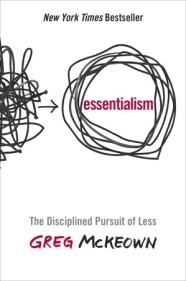
Essentialism
Greg McKeown, 2014
The idea in one sentence: Almost everything is noise, so the discipline that matters is choosing the very few things that count and saying no to the rest, politely and often.
McKeown's method has three moves. Explore: look at more options than feels comfortable before committing, and apply a hard test, "is this a clear yes?" Eliminate: cut commitments that are merely good, including ones you already agreed to, and build in buffers because everything takes longer than planned. Execute: make the essential things effortless with routines, so you never rely on heroics.
The everyday example is the school fundraiser. You are asked to bake, run a stall and join the committee. The essentialist asks which one, if any, matters to the child, does that one well, and declines the others with a short, kind sentence rather than a long excuse.
What it gets wrong: it is written for people who can say no. If your manager assigns the work and your partner travels, your room to eliminate is real but smaller than McKeown implies. The second half also repeats itself. Even so, the shift from "how do I fit it all in" to "what is worth fitting in" changes weeks.
- Before saying yes to anything new, ask whether it is a clear yes; if you hesitate, decline.
- Add a 50 per cent buffer to every time estimate this week and count the deadlines you stop missing.
- Pick one recurring obligation that is merely good and drop it this month.
Read it if: your calendar is full of things you agreed to because no felt rude.
Skip it if: you already say no easily and your problem is finishing, not choosing.
If it isn't a clear yes, then it's a clear no. - Greg McKeown
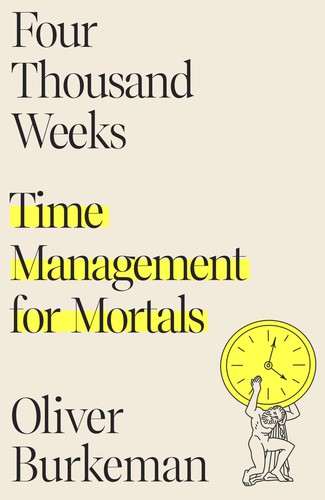
Four Thousand Weeks
Oliver Burkeman, 2021
The idea in one sentence: You will never clear the list, and the healthiest move is to accept that and consciously choose what to neglect.
Burkeman starts with arithmetic. An eighty-year life is about four thousand weeks, and no system turns that into enough time for everything you could care about. The productivity industry sells the opposite promise, and getting more efficient only pulls more demands toward you, like emptying an inbox faster and receiving more replies. He calls this the efficiency trap.
The useful parts are the principles near the end: pay yourself first with time, limit work in progress to three projects, and accept that choosing one thing is choosing not to do a thousand others. The everyday example is the parent who stops trying to have a spotless house, a side project and a social life, picks two, and finds the guilt mostly evaporates.
Where it falls short: it is a philosophy book in a productivity jacket, so if you came for tactics you will leave with few, and the chapters on patience are slow. It ranks fourth because, for the people this site is written for, the problem is usually too much, not too little technique, and this is the only book here that says so.
- Keep an open list of everything you might do and a closed list of no more than ten you will do; move items across only when one finishes.
- Cap active projects at three and refuse to start a fourth until one is done.
- Decide in advance what you will be bad at this year, and stop apologising for it.
Read it if: every other book on this page has left you feeling behind.
Skip it if: you want a system with steps; this book deliberately refuses to give you one.
The average human lifespan is absurdly, terrifyingly, insultingly short. - Oliver Burkeman
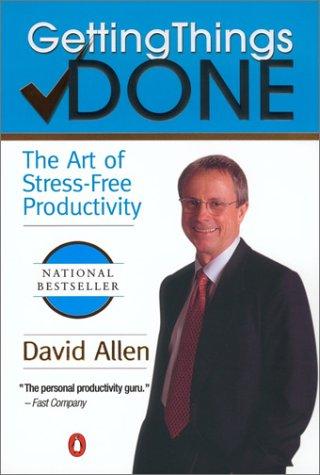
Getting Things Done
David Allen, 2001
The idea in one sentence: Your head is a bad place to store tasks, so capture everything in a trusted external system, decide the next physical action for each item, and review it all weekly.
GTD is the grandparent of every task app you have used. The workflow has five steps: capture (everything into one inbox), clarify (what is this, and what is the very next action), organise (into lists by context: calls, errands, at computer), reflect (a weekly review of every list) and engage (do the work). The two-minute rule, which Clear later borrowed for habits, started here: if a next action takes under two minutes, do it now rather than filing it.
The everyday version: "sort out the car insurance" is not a task, it is a project. The next action is "find last year's renewal email", and once that is written where you will see it, the 3 a.m. worry stops.
The book itself is long, corporate in tone and written for an era of paper files and desk phones. The 2015 revision helps but does not cure it. Most people get everything they need from the five steps and the weekly review, which is why the verdict is to run the system and skim the text.
- Put every task, worry and idea into one inbox today, then process it to empty once a day.
- Rewrite every item on your list as a physical next action that starts with a verb.
- Book a 30-minute weekly review every Friday or Sunday and never skip it.
Read it if: you have open loops in your head, on sticky notes, in three apps and on your hand.
Skip it if: you already run a simple list and a weekly review; the book will not add much.
Your mind is for having ideas, not holding them. - David Allen

Make Time
Jake Knapp and John Zeratsky, 2018
The idea in one sentence: Pick one highlight for each day, redesign your phone and surroundings so distractions take effort, and keep only the tactics that work for you.
Knapp and Zeratsky, both former Google designers, helped build the apps that eat your attention and then wrote the manual for escaping them. Their frame has four steps: highlight (choose one thing, 60 to 90 minutes long, that will make today feel worthwhile), laser (protect your attention while doing it), energise (sleep, food, movement) and reflect (a few notes each evening on what worked). Around that sit more than 80 small tactics to test, from the "distraction-free phone" (delete email, social and browser apps) to "skip the morning check-in".
The everyday example: the highlight on a packed Wednesday might be "an hour with the kids without my phone in the room". Productivity, here, includes that.
What it gets wrong: a few tactics are gimmicky, the illustrated style can feel like a pitch deck, and the authors had unusual freedom when they tested their ideas. But because it is a menu rather than a prescription, it survives messy weeks better than almost anything else on this list.
- Each morning, write one highlight for the day and schedule it before anything else goes in the calendar.
- Delete email and social apps from your phone for one week and notice how often you reach for the empty space.
- Spend two minutes each night noting which tactic you tried and whether it helped.
Read it if: you want tactics rather than theory and are willing to experiment.
Skip it if: you have already cleaned up your phone and plan your day around one priority; you are living the book.
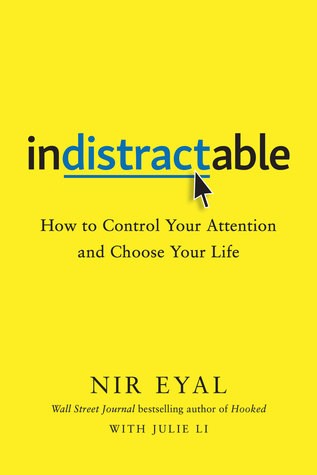
Indistractable
Nir Eyal, 2019
The idea in one sentence: Distraction starts inside you, as an escape from discomfort, so the fix begins with the feeling, then the schedule, then the apps.
Eyal, who earlier wrote a book on how to build habit-forming products, turns the lens around. His model has four parts: master internal triggers (notice the boredom or anxiety that sends your hand to the phone), make time for traction (timebox your values, including relationships, not only tasks), hack back external triggers (kill notifications, tell colleagues you are heads-down) and prevent distraction with pacts (effort, price and identity pacts).
The chapter that lands for parents is the one on children. Eyal argues that kids reach for screens for the same reasons adults do, unmet needs for autonomy, competence and connection, and that confiscating the tablet treats the symptom. The ten-minute "surf the urge" exercise, where you name the feeling and wait, is the tactic most readers keep.
Where it is weaker: the research is lightly cited, some sections are padded with opinion about tech companies, and the pacts can feel like the author's own routine dressed up as a rule. The internal-trigger insight, though, is missing from every other book here.
- When you feel the urge to check your phone, name the feeling behind it and wait ten minutes before acting.
- Timebox your week with slots for relationships and rest, not only work, so you can tell traction from distraction.
- Turn off every notification except calls and messages from people who would ring you in an emergency.
Read it if: you have tried app blockers and still end up scrolling, and want to know why.
Skip it if: you want a quick fix; the book asks you to sit with discomfort first.
The opposite of distraction is traction. - Nir Eyal

168 Hours
Laura Vanderkam, 2010
The idea in one sentence: A week has 168 hours, and once you track where yours actually go, you will find more room for what matters than you believed.
Vanderkam's method is almost embarrassingly simple: log your time in half-hour blocks for one full week, then look at the totals. People who say they work 60 hours usually work 45. People who "have no time to exercise" spend eleven hours on television. The point is arithmetic, not shame. Subtract 56 hours of sleep and 45 of work from 168 and 67 hours remain, which is a lot of life.
Her second move is to fill those hours deliberately: name your core competencies, the few things only you can do well (your work, your children, your health), and outsource or ignore the rest. The everyday example is the mother who thought she would never read again and found a daily hour hiding in two commutes and one evening of background television.
Where it is dated: it was written before smartphones ate the hours it describes, some outsourcing advice assumes an income most readers do not have, and the career chapters run long. The time log alone, though, changes how you argue with yourself about time.
- Track every half hour of one normal week on paper or in a spreadsheet, then total the categories.
- Name three core competencies, the things only you can do for your family or work, and protect them first.
- Pick one recurring chore to drop, delegate or do badly, and give the hours to something you keep saying you have no time for.
Read it if: you are a working parent who says "I have no time" at least once a day.
Skip it if: you already track your time and know where it goes; the rest is examples.

The One Thing
Gary Keller and Jay Papasan, 2013
The idea in one sentence: Ask what one thing you could do that would make everything else easier or unnecessary, then protect the hours to do it.
The book is built around a single question, the focusing question, and a domino image: knock down the right small domino and it topples bigger ones in sequence. Keller and Papasan then ask you to block four hours each morning for your one thing and defend that block against everything. Their list of "lies", that multitasking works, that everything matters equally, that discipline is the goal, is a brisk clearing of the ground.
The everyday example: if your one thing this quarter is finding a better job, the one thing today is sending two applications before you open anything else, and the laundry can wait.
What it gets wrong: four protected hours a day is a fantasy for most people, the book is a quarter of its page count once you strip the repetition, and it leans on sales-career examples. The question is excellent. The question is also the whole book, which is why a summary gives you nearly all of it.
- Each morning, write the one task that would make the rest of the day easier, and do it first.
- Block the same hour every day for that task and tell the people around you it is not available.
- Replace the long to-do list of equal items with a short success list ordered by impact.
Read it if: you want a single, memorable question to reorganise your priorities around.
Skip it if: you have read the question above; that was most of it.
Extraordinary results are directly determined by how narrow you can make your focus. - Gary Keller
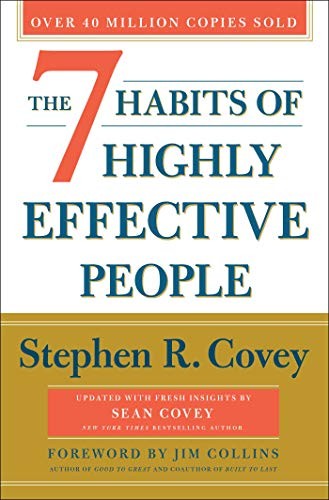
The 7 Habits of Highly Effective People
Stephen Covey, 1989
The idea in one sentence: Effectiveness comes from character and principles, not tricks, so fix who you are, then how you plan, then how you work with others.
Covey's seven habits run in sequence. The first three are about self: be proactive, begin with the end in mind, put first things first. The next three are about others: think win-win, seek first to understand, synergise. The seventh, sharpen the saw, is renewal. The tool everyone remembers is the time-management matrix from habit 3, which sorts tasks by urgent and important and shows that most of us live in quadrant one (urgent and important) and quadrant three (urgent and unimportant), while the things that would change our lives sit untouched in quadrant two.
The everyday example: a parent's week is almost all quadrant one, and the quadrant-two items, exercise, a planning hour, a proper conversation with a teenager, keep getting bumped. Covey's answer is to schedule quadrant two first and let the urgent fill the gaps.
Where it is dated: the corporate anecdotes are long, the language is 1980s management-speak, and the family stories can grate. Habits 2, 3 and 5 remain some of the best thinking on this list; the rest you can skim.
- Draw the four-quadrant matrix and sort last week's tasks into it, honestly.
- Book one quadrant-two activity into next week before anything urgent gets in.
- In your next disagreement, restate the other person's position to their satisfaction before giving your own.
Read it if: you want a framework that covers work, family and health together, and you have patience for a long book.
Skip it if: you want tactics this week; there are faster books higher on this list.
Begin with the end in mind. - Stephen Covey
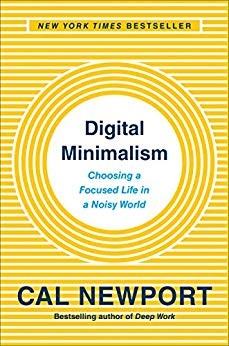
Digital Minimalism
Cal Newport, 2019
The idea in one sentence: Decide what you value, then use only the technology that clearly serves those values, and only in the ways that serve them best.
Newport's method is a 30-day digital declutter. Step away from every optional technology for a month, use the time to rediscover activities you find satisfying (walking, repairing things, conversation), then reintroduce only the tools that pass a strict test: does this directly support something I deeply value, and is it the best way to do so? He adds practices such as leaving the phone at home on walks, scheduling low-quality leisure rather than drifting into it, and replacing likes with actual phone calls.
The everyday example is the parent who, after the declutter, keeps WhatsApp for the family and the school but opens it twice a day at set times instead of two hundred times.
What it gets wrong: the long sections on solitude and the Amish can feel like a lecture, the 30-day plan asks more than most people with a job and children can give, and it overlaps heavily with Deep Work. It is here because the declutter works, and because it is the only book on the list that treats leisure as seriously as work.
- Pick one optional app and remove it from your phone for 30 days, then decide whether to let it back.
- Schedule two fixed times a day for messages and keep the app closed otherwise.
- Replace one evening of scrolling this week with a planned activity that uses your hands.
Read it if: your phone is the problem and you are ready for a month-long reset rather than a tweak.
Skip it if: you have read Deep Work and already cleaned up your phone; the overlap is large.

Eat That Frog
Brian Tracy, 2001
The idea in one sentence: Do your biggest, most unpleasant and most important task first thing in the morning, before the day gets a chance to eat you.
The frog is the task you are most likely to avoid and most need to do. Tracy's 21 short chapters give variations on getting it done: plan the night before, apply the 80/20 rule to your list, rank tasks A to E by consequence, slice big jobs small, and practise "single-handling", staying on one task until it is finished. The everyday example is the tax return or the awkward call to the school that you have moved from Monday to Friday: Tracy's rule is that it goes first on Monday, before email, and the week feels lighter for it.
Where it falls short: it is one idea with twenty restatements, several chapters are motivational filler, and there is almost nothing on why we procrastinate, which Indistractable and Atomic Habits both handle better. The advice works, but a summary gives you all of it in six minutes, which is why it sits at twelve.
- Before closing your laptop tonight, write down tomorrow's frog and put it at the top of the list.
- Do that task before opening email or messages, even if it takes only fifteen minutes.
- Rank the rest of your list A to E by consequence and never do a B while an A is undone.
Read it if: you want a single rule you can start tomorrow morning and you enjoy a pep talk.
Skip it if: you already do your hardest task first; there is nothing more here.
If you have to eat two frogs, eat the ugliest one first. - Brian Tracy
Which productivity book should you read first?
- If your problem is that you cannot get started, or you start and stop, start with Atomic Habits, because the two-minute rule and habit stacking fix starting before anything else can work.
- If your problem is being busy all day but never finishing the work that matters, start with Deep Work, because it explains why fragmented attention costs so much and gives you a daily block to fix it.
- If your problem is too many commitments, start with Essentialism, because it teaches the skill the others assume, saying no.
- If your problem is that productivity advice itself makes you anxious, start with Four Thousand Weeks, because it is the only book here that admits the list will never be finished and shows you how to live with that.
- If your problem is open loops and waking at 3 a.m., start with Getting Things Done, or just its five steps and a weekly review, because a system quiets the mind faster than a mindset.
- If your problem is the phone, start with Make Time, because its tactics work in a week and need no month-long retreat.
Productivity books that are overrated
The 4-Hour Workweek by Tim Ferriss changed how a generation thought about automation, outsourcing and batching, and the low-information diet is still decent advice. But the life it sells, remote income, virtual assistants and months abroad, is mostly available to single people with no dependants and a product to sell. The two chapters on batching email and cutting low-value work are useful; a summary gives you both.
The Miracle Morning by Hal Elrod prescribes a six-part routine (silence, affirmations, visualisation, exercise, reading, writing) before dawn. The idea that a deliberate morning beats a reactive one is sound. The specific routine, though, is one page of content inside a book-length pep talk, and for anyone already woken at 5 a.m. by a toddler, "wake earlier" is not a plan. Read the one-page version and build your own.
The Power of Habit by Charles Duhigg is well-written journalism and the book that introduced most readers to the cue, routine, reward loop. It is here because Atomic Habits takes the same loop, adds a fourth step and a practical system, and does it in a more usable form. If you read Clear, Duhigg's case studies on Febreze and Target are enjoyable but not necessary.
Read next
Questions people ask
What is the best productivity book of all time?
For most people it is Atomic Habits, because it solves starting, which is where every other system breaks down. If you want the most influential rather than the most useful, that is Getting Things Done, whose five-step workflow sits under every task app made since 2001. Deep Work is the best book on focus specifically.
What productivity book should I read first?
Match the book to your problem, not its fame. Atomic Habits if you struggle to start, Essentialism if you struggle to say no, Deep Work if you struggle to focus, Getting Things Done if you forget things. Not sure? Read the six-minute summaries of those four, pick the one that sounds like your week, and read that book in full.
Are productivity books worth reading?
Two or three of them, yes. After that they repeat each other, because the field has only a handful of real ideas: capture tasks outside your head, protect blocks of attention, shrink habits until they are easy, and choose fewer things. Read in full the ones that give you a system or a mechanism. The rest are motivation, which a summary provides in six minutes.
What is the best book on time management?
Getting Things Done if you want a complete system, 168 Hours if you want to see where your week actually goes, and Four Thousand Weeks if you want to stop fighting the clock. Most time-management books are priority books in disguise, which is why Essentialism and The 7 Habits appear on those lists too. Start with the time log from 168 Hours; it costs nothing.
Is Deep Work worth reading?
Yes, if your work involves thinking and you can protect at least one block a day. The first half, on attention residue and why focused hours beat long ones, is the best argument in the genre. The second half assumes more control over your calendar than most people have, and the social media chapter has aged. Adapt the advice to a 45-minute block and skip the parts about quitting the internet.
Which productivity book is best for working parents?
Atomic Habits for the two-minute rule, which survives interrupted days, and Four Thousand Weeks for permission to stop trying to do everything. 168 Hours was written with working parents in mind and its time log finds hours you did not know you had. Deep Work needs adapting: one protected 30 to 45 minute block, not four-hour mornings. Skip anything that assumes you can wake earlier.
Books in this article
Atomic Habits
Small habits, repeated daily, compound into big results. Build them with four simple laws.

The Psychology of Money
Doing well with money is about behaviour, not intelligence: luck, enough, time, and freedom.
Deep Work
Four hours of real concentration beat ten hours of busy work. Protect them with rituals and a hard stop.