Best-of list · Psychology and Mindset
Best Self-Help Books: 12 That Actually Help, Honestly Ranked for 2026
The best self-help book for most people is Atomic Habits by James Clear, because almost every other book in the genre tells you what to change, and this is the one that shows you how to keep doing it after the first bad week. This list of the best self-help books was built by reading each book in full, trying the advice for at least two weeks, and then asking one question of every chapter: does this still help on a Wednesday when you have slept five hours, the inbox is full and a child needs picking up at three? Books that need a quiet retreat or a personality transplant ranked lower, however many copies they sold. Where a six-minute summary gives you everything the book does, we say so, because your time is the point. The list is for people with a job, a family and no spare evenings.
Quick picks
| Rank | Book | Best for | Pages | Verdict |
|---|---|---|---|---|
| 1 | Atomic Habits, James Clear | Making any change stick | 320 | Read it |
| 2 | Feeling Good, David Burns | Low mood, anxiety and harsh self-talk | 706 | Read the first half, keep the worksheets |
| 3 | The Psychology of Money, Morgan Housel | Money worry on a normal salary | 256 | Read it |
| 4 | How to Win Friends and Influence People, Dale Carnegie | Getting on with people at work and home | 291 | Read part one and three, skim the rest |
| 5 | Man's Search for Meaning, Viktor Frankl | A hard year | 165 | Read it, in one sitting if you can |
| 6 | The Subtle Art of Not Giving a F*ck, Mark Manson | Caring about too much | 224 | Read it once |
| 7 | Mindset, Carol Dweck | Parents, teachers and anyone afraid of failing | 320 | Read chapters 1 to 3 and 7 |
| 8 | Daring Greatly, Brené Brown | Perfectionism and shame | 287 | Read it, slowly |
| 9 | Deep Work, Cal Newport | Focus at work | 304 | Read the first half, adapt the second |
| 10 | The 7 Habits of Highly Effective People, Stephen Covey | A whole-life framework | 381 | Read habits 1, 2 and 5 |
| 11 | The Power of Now, Eckhart Tolle | Rumination and a loud mind | 229 | Summary is enough for most |
| 12 | Ikigai, Héctor García and Francesc Miralles | A gentle reset at a turning point | 208 | Summary is enough |
How we ranked the best self-help books
Most lists of self-help books are ordered by sales or fame. We ordered ours by how much of the advice is still in use after a normal week for an adult with a job, a household and a phone that never stops. Each book was read cover to cover, the main method was tried for at least two weeks, and it was scored on three questions.
- Does the advice survive a real week, with interruptions, tiredness and other people, or does it only work with a quiet house and an empty calendar?
- Does the book rest on more than the author's own story? Research, clinical practice or years of evidence ranked higher than one dramatic turnaround.
- How much of the book does a good summary replace? If the whole idea fits on a page, we say so and rank the book lower, however good the idea.

Atomic Habits
James Clear, 2018
The idea in one sentence: Results come from systems rather than goals, so build tiny habits, attach them to your existing routine and shape your surroundings until the right action is the easy one.
Self-help has a dirty secret: most of it is advice about what to do, and almost none of it is advice about how to keep doing it. Clear's book fills that gap. His four laws, make it obvious, attractive, easy and satisfying, each come with a tool you can use tonight. The two-minute rule shrinks a habit until it takes under two minutes, so "meditate daily" becomes "sit down and take three breaths".
The chapter that matters most for the rest of this list is the one on identity: the goal is not to read a book but to become a reader, and every small action is a vote for who you are. Every other book here asks you to change how you think or feel. This one shows you how to turn that into something you do on a Tuesday.
Where it is weak: it is long for its content, the business anecdotes are padding, and it says little about why you resist change, which is where Burns and Brown pick up. It is still the book to read first.
- Shrink any new habit until it takes under two minutes, then let it grow.
- Write the habit as "after X, I will Y" and attach it to something you already do every day.
- Rearrange your phone, desk and kitchen so the good choice is visible and the bad one takes effort.
Read it if: you finish self-help books inspired and have changed nothing by the following month.
Skip it if: you have already read two habit books; the system is the same, only better explained.
You get what you repeat. - James Clear

Feeling Good
David Burns, 1980
The idea in one sentence: Your mood follows your thoughts, most low moods come from a short list of thinking errors, and you can learn to catch and correct those errors on paper.
This is the only book on the list that has been tested the way a medicine is tested. Burns, a psychiatrist, wrote it to bring cognitive behavioural therapy out of the clinic, and later trials found that people with mild to moderate depression who were simply given the book improved measurably.
Burns lists ten cognitive distortions, among them all-or-nothing thinking, overgeneralisation, mind reading and "should" statements. You then use the triple-column technique: write the automatic thought, name the distortion, write a fairer response. The parent who snaps at a child at bedtime and thinks "I am a terrible mother" is labelling and thinking in all-or-nothing terms. The fairer response is "I was short with her once at the end of a long day, and I will apologise tomorrow". It works because it is simple enough to do at 10 p.m.
Where it falls short: it is enormous, the later chapters on medication are dated and the tone is very 1980. Read the first half, photocopy the distortion list, and treat the rest as reference.
- Keep the ten distortions somewhere visible and name the one you are using whenever your mood drops.
- Once a day, write one upsetting thought in three columns: the thought, the distortion, a fairer response.
- Watch for the word "should" in your self-talk and replace it with "it would be nice if".
Read it if: you talk to yourself in a way you would never talk to a friend, or you are waiting months for a therapist.
Skip it if: your low mood is severe or you have had thoughts of harming yourself; see a doctor first, then read it alongside treatment.

The Psychology of Money
Morgan Housel, 2020
The idea in one sentence: Doing well with money is about behaviour rather than intelligence, so the skills that matter are patience, humility about luck, a sense of "enough" and buying back control of your time.
Most money books are investing books in disguise. Housel's is a self-help book that happens to be about money. His nineteen short chapters each take one piece of human behaviour and show how it shapes a bank balance: nobody is crazy, because everyone's money decisions make sense given what they have lived through, and the hardest financial skill is getting the goalpost to stop moving.
The chapter that changes weeks is the one on freedom. Housel argues that the real return on savings is control over your own hours, and any parent who has traded time for salary knows what that is worth. His other gift is the word "enough". One sentence defining enough for your family ends a lot of comparison with the neighbours.
What it gets wrong: the examples are American and there are no step-by-step instructions. For the person whose problem is worry rather than arithmetic, there is no better money book.
- Write one sentence that defines "enough" for your household and keep it in your phone.
- Set up an automatic transfer on payday, however small, into an account you do not look at.
- Before judging anyone's money choices, including your own past ones, ask what they had lived through.
Read it if: money makes you anxious even when the numbers are fine.
Skip it if: you want a how-to on investing; this is a book about behaviour, not products.
Controlling your time is the highest dividend money pays. - Morgan Housel

How to Win Friends and Influence People
Dale Carnegie, 1936
The idea in one sentence: People respond to genuine interest, appreciation and being allowed to save face, so stop criticising, start listening and let others feel the idea was theirs.
Ninety years old and still the most useful book on dealing with people, because people have not changed. Carnegie's principles are almost embarrassingly plain: do not criticise, condemn or complain; give honest appreciation; become interested in other people; remember names; let the other person talk; admit your mistakes quickly; ask questions rather than giving orders.
It ranks this high because the advice survives every kind of week. The everyday test is a disagreement with a partner, a teenager or a colleague. Carnegie's rule is to begin with what you agree on, state their case better than they did, and only then say your piece.
What has aged: the salesmanship, the all-male cast and the occasional whiff of manipulation. Read it as a book about kindness that happens to work.
- For one week, do not criticise anyone, at home or at work, and notice what happens to the mood around you.
- In your next disagreement, restate the other person's view until they say "yes, exactly" before giving your own.
- Use people's names, ask about what they care about, and let them finish.
Read it if: the hardest part of your week is other people.
Skip it if: you already listen more than you talk and never say "you always"; you are living the book.
You can't win an argument. - Dale Carnegie

Man's Search for Meaning
Viktor Frankl, 1946
The idea in one sentence: Even when everything else is taken away, a person keeps the freedom to choose their response, and that choice, anchored in something to live for, is what carries people through.
Frankl was a psychiatrist who spent three years in Nazi concentration camps and lost his wife, parents and brother. The first half describes what he saw. The second half sets out logotherapy, his approach built on the idea that people are driven first by a need for meaning rather than pleasure or power. Meaning comes from three places: work that matters, love for another person, and the attitude you take toward suffering you cannot avoid.
The everyday version is small by comparison but real: the person caring for an ill parent, the redundancy, the slow year after a loss. Frankl does not promise it will feel better. He says you can decide what the hard thing means and how you will carry it, and that decision is yours alone.
Where it is weaker as self-help: there are no exercises, and the logotherapy section is denser than the memoir. It ranks fifth because it is a book to turn to, not one to practise daily.
- When you cannot change a situation, write down what you can still choose: your words, your routine, who you lean on.
- Name the one thing or person your hard season is for, and say it out loud when it gets bad.
- Treat "why" as a question you answer, not one you wait to be answered for you.
Read it if: you are going through something that tips and tactics do not touch.
Skip it if: you want a system with steps; this is a short, hard, beautiful book, not a workbook.

The Subtle Art of Not Giving a F*ck
Mark Manson, 2016
The idea in one sentence: You have a limited supply of care, so stop spending it on things that do not matter, accept that struggle is part of any life worth having, and choose better problems.
Manson's book is the anti-self-help self-help book, and it sold sixteen million copies because people were tired of being told to be positive. His argument is that chasing constant happiness makes people miserable, that most of what we worry about is other people's opinions, and that the real question is not "how do I avoid problems" but "which problems do I want". Good values, he says, are ones you control, such as honesty and curiosity; bad values depend on others, such as being liked.
The everyday example is the parent exhausted by caring about the school WhatsApp group, a colleague's tone in an email and whether the packed lunches look as good as everyone else's. Manson's test is to ask which of these you would still care about if nobody was watching. The list shrinks fast.
What it gets wrong: it is one idea stretched to a book, the swearing grates by chapter four, and much of the philosophy is Stoicism with the labels removed.
- Write down everything you worried about this week and cross out anything that depends on someone else's opinion of you.
- Choose your problems on purpose: a hard project you believe in beats an easy week you resent.
- When something goes wrong, ask "what is this responsibility teaching me" rather than "whose fault is this".
Read it if: you are worn out from caring about everything and want permission to care about less.
Skip it if: you have read a little Stoic philosophy; you have met these ideas already, with fewer swear words.
Who you are is defined by what you're willing to struggle for. - Mark Manson

Mindset
Carol Dweck, 2006
The idea in one sentence: People who believe ability is fixed avoid challenge and crumble at setbacks, while people who believe ability grows with effort keep learning, and the belief itself can be changed.
Dweck is a Stanford psychologist, and the book rests on decades of her research. The central finding is simple. Tell a child they are clever and they will choose easier tasks to protect the label. Praise the effort and the method, and they will pick harder ones. Adults do the same at work: the fixed-mindset manager hides mistakes, the growth-mindset one treats them as data.
It ranks well for a busy adult because the shift costs nothing and shows up everywhere. The everyday example is homework. "You are so good at maths" becomes "you kept going on that problem for twenty minutes", and the child's response to hard problems changes. The same move works on yourself: "I am bad at money" becomes "I have not learnt about money yet".
What has gone wrong since: schools turned the idea into posters and slogans, and some large later studies found smaller effects than the early ones. Dweck added a chapter on "false growth mindset" to the updated edition, warning that praising effort without teaching strategy achieves nothing. The book is also repetitive. Read the first three chapters and the one on parenting.
- Replace praise for talent with praise for effort, strategy and persistence, for your children and for yourself.
- Add the word "yet" to any sentence that starts "I can't".
- When you avoid a task, ask whether you are protecting a result or protecting an image of yourself.
Read it if: you have children, you manage people, or you notice you stop trying the moment something gets hard.
Skip it if: you already praise process over outcome; the research chapters will not add much.
Becoming is better than being. - Carol Dweck
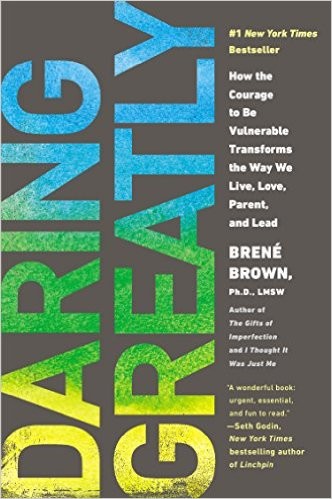
Daring Greatly
Brené Brown, 2012
The idea in one sentence: Shame, the fear of being seen as not good enough, drives perfectionism and numbing, and the way out is the willingness to be seen anyway.
Brown is a research professor who spent years interviewing people about shame. Her argument is that vulnerability, which most of us treat as weakness, is what makes connection, creativity and good leadership possible. Its opposite is armour: perfectionism, cynicism, numbing with food, phones or busyness, and rehearsing disaster so joy cannot catch us out.
Brown's line on parenting is that children do what we do, not what we say, so a parent who cannot forgive their own mistakes teaches a child to hide theirs. The everyday example is the mother who stays up until midnight finishing a school project to a standard nobody asked for. Brown would ask whose approval that is for.
Why it is here rather than The Gifts of Imperfection: the earlier book is shorter and has ten tidy guideposts, but Daring Greatly has more of the research and covers work and parenting, where most readers meet the problem. Where it falls short: it is wordy, the vocabulary can feel like a club, and there is no method, only an attitude. The attitude survives any week.
- Notice the moment you reach for armour, a joke, a snap, a phone, and name what you are afraid of.
- Share one unfinished, imperfect thing this week, a draft, a worry, an apology, and see what happens.
- Stop rehearsing disaster during good moments; let them be good.
Read it if: you redo other people's work, apologise for your feelings and cannot remember the last time you asked for help.
Skip it if: you want steps; Brown gives you a way of seeing, and leaves the steps to you.
Vulnerability is the birthplace of innovation, creativity and change. - Brené Brown

Deep Work
Cal Newport, 2016
The idea in one sentence: Sustained concentration is a skill that modern work has let rot, and the people who rebuild it, even for an hour a day, produce more and feel calmer.
Most self-help books are about the inside of your head. Newport's is about your attention, which the world is actively trying to take. He splits work into deep (hard, valuable, needs full focus) and shallow (email, chat, meetings that could be a message), and uses the idea of attention residue to show why every "quick check" of the phone costs far more than thirty seconds.
The philosophy half, on why focus matters and why it is rare, holds up completely. The tactical half, with its professors who disappear for whole summers, needs translating for a normal life. Translated, it becomes one protected block a day, phone in another room, and a shutdown ritual so the job stops following you to the dinner table.
Why it ranks ninth here when it is second on our productivity list: the book assumes you own your calendar, and most people do not. It is in rather than Essentialism because attention residue changes behaviour the day you understand it, whereas saying no is a skill that takes months.
- Protect one block a day, even 30 minutes, for your hardest task, and treat it like an appointment.
- Keep the phone out of the room during that block; a glance costs fifteen minutes of focus.
- End work with a two-minute shutdown: note open tasks, plan tomorrow, say a closing phrase.
Read it if: your work needs thought and you can defend one block a day.
Skip it if: your job is reactive by nature, or you already guard a daily focus block; the second half will frustrate you.
A deep life is a good life. - Cal Newport
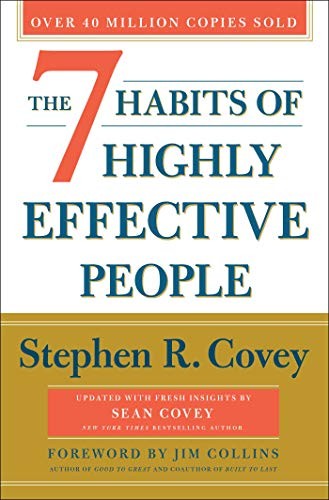
The 7 Habits of Highly Effective People
Stephen Covey, 1989
The idea in one sentence: Lasting effectiveness comes from character rather than technique, so work from the inside out: take responsibility, decide what matters, do it first, then learn to work with others.
Covey's book has topped lists of the best self-help books for more than thirty years, and the first habit alone explains why. Be proactive is the idea that between what happens to you and how you respond there is a gap, and your life is built in that gap. The second, begin with the end in mind, asks you to write what you would want said at your own funeral and plan backwards. The fifth, seek first to understand, then to be understood, is the best single rule for marriage and management in print.
The everyday example is the parent who writes a short family mission statement, three lines about what this household is for, and finds it settles arguments about screens and chores.
Why it sits at ten: the book is long, the corporate language has aged badly, and the middle habits on win-win and synergy are padding dressed as philosophy. A busy adult gets ninety per cent of the value from habits 1, 2 and 5, about a third of the pages.
- When something goes wrong, pause before you respond and ask what is inside your control.
- Write three lines about what you want your life to have been about, and check this month's calendar against them.
- In any disagreement, repeat the other person's view back until they agree you have understood it.
Read it if: you want one book that covers work, family and character, and you have patience for a long read.
Skip it if: you want help this week; there are faster books higher on this list.
Seek first to understand, then to be understood. - Stephen Covey

The Power of Now
Eckhart Tolle, 1997
The idea in one sentence: Most suffering comes from identifying with the voice in your head, and peace is available in any moment you step out of that voice and notice what is actually here.
Tolle's book is the most spiritual title on this list. Strip away the vocabulary and the core is a single, workable practice: notice that you are thinking, notice that the thought is about the past or the future, and bring your attention back to your breath, your body or the room. The running commentary in your head, he argues, is not you; you are the one who can watch it.
The everyday example is lying awake at 1 a.m. replaying a conversation with your manager and then imagining tomorrow's. Tolle's move is to ask what problem you have right now, this second, lying in a bed. Usually there is none. It costs nothing and works.
Where it falls short: it is repetitive, the metaphysics about pain-bodies will lose many readers, and there is almost no structure. The practice fits on an index card, and a good summary gives you the card.
- Several times a day, ask "what problem do I have right now, this second" and answer honestly.
- When you catch yourself replaying or rehearsing, name it ("thinking") and take one slow breath.
- Do one routine task a day, washing up or walking to the car, with full attention and no phone.
Read it if: your mind will not stop and meditation apps have not helped you understand why.
Skip it if: spiritual language puts you off; take the practice from a summary and skip the book.
Realize deeply that the present moment is all you ever have. - Eckhart Tolle

Ikigai
Héctor García and Francesc Miralles, 2016
The idea in one sentence: The long-lived people of Okinawa share a few habits anyone can copy, a reason to get up, a small close community, light eating, daily gentle movement and work that absorbs them.
Every list of the best self-help books needs one book about what the self-improvement is for, and there were four candidates for this slot. Thinking, Fast and Slow is a brilliant book about how the mind makes mistakes, but at nearly 500 dense pages it is a psychology textbook, not a change you make on a weekday. Can't Hurt Me is a gripping memoir, but its advice, to treat comfort as the enemy and run until your feet bleed, does not survive a household and a job. Four Thousand Weeks is already on our productivity list. Ikigai won because it is short, kind and asks for small things that fit a real week.
García and Miralles visited Ogimi, an Okinawan village with an unusual number of centenarians. The habits that matter are the moai, a small group of friends who meet for life; hara hachi bu, stopping when 80 per cent full; and steady low-level movement rather than gyms. The everyday example is the mother who has not seen her friends properly in a year and sets a standing fortnightly hour with two of them.
Where it is weak: the evidence is thin, much of it is borrowed from books on flow and Stoicism, and the four-circle "ikigai diagram" shared online is not Japanese and is not in the book. It ranks twelfth because the five useful habits fit on a page, and our summary has that page.
- Message two or three friends you genuinely like and set a standing time to meet, even for thirty minutes.
- Serve yourself a little less than you want and stop at 80 per cent full for one week.
- Write one small reason you get up in the morning that is not an obligation, and protect it.
Read it if: you are at a turning point and want a gentle evening's read rather than a programme.
Skip it if: you want research or a method; take the five habits from the summary and move on.
Which self-help book should you read first?
- If your problem is that you know what to change but it never sticks, start with Atomic Habits, because it fixes the doing, which every other book takes for granted.
- If your problem is low mood, anxiety or a cruel inner voice, start with Feeling Good, because its method has been tested in clinical trials and works on paper, at night, with no appointment.
- If your problem is money worry on a decent income, start with The Psychology of Money, because it treats the anxiety rather than the spreadsheet.
- If your problem is other people, at work or at home, start with How to Win Friends and Influence People, because its rules are plain and still defuse arguments better than anything written since.
- If your problem is a hard season that tips do not touch, start with Man's Search for Meaning, because it takes three hours and changes what you think a hard year is for.
- If your problem is perfectionism and never feeling enough, start with Daring Greatly, because it names the thing underneath, shame, which habit books never mention.
Self-help books that are overrated
The Secret by Rhonda Byrne is the best-selling example of the law of attraction, the idea that thinking positively about what you want draws it to you. There is a small true thing inside it: people who expect good outcomes try more often. But the book turns that into a claim that thoughts alone change the world, which makes illness and poverty the fault of the sufferer's mindset, and it quietly discourages the thing that works, which is action. Read Mindset instead; it gives you the useful part without the magic.
The 5 AM Club by Robin Sharma sells a morning routine of twenty minutes of movement, twenty of reflection and twenty of learning, wrapped in a 300-page fable about a billionaire mentor. The underlying point, that an hour you own before the day starts is valuable, is fair. The specific prescription is a page of content inside a very long story, and for anyone woken at 5 a.m. by a child, "wake earlier" is not advice. Build a short morning habit with the two-minute rule and skip the fable.
Rich Dad Poor Dad by Robert Kiyosaki taught a generation the difference between assets, which pay you, and liabilities, which cost you, and that one idea is worth keeping; it is why we summarised the book. The rest is harder to defend: the rich dad may be a composite, the attitude to debt and risk is dangerous for a family, and the property advice has aged badly. Take the two-column exercise and read The Psychology of Money for everything else.
Read next
Questions people ask
What is the best self-help book of all time?
By influence, How to Win Friends and Influence People and The 7 Habits of Highly Effective People, which have topped lists for decades. By usefulness to a busy adult today, Atomic Habits, because it solves the problem every other book leaves you with: how to keep doing the thing. By evidence, Feeling Good, the one self-help book that has been tested in clinical trials.
What self-help book should I read first?
Match the book to the problem, not to its fame. Atomic Habits if change never sticks, Feeling Good if your mood or self-talk is the issue, How to Win Friends and Influence People if other people are, The Psychology of Money if money worry is. If you cannot decide, read the summaries on this page, pick the one that sounds like your week, and read that book in full.
Do self-help books actually work?
Some do, when they give you a method and you use it. Cognitive behavioural therapy books such as Feeling Good have been shown in trials to reduce mild to moderate depression. Habit books work when you apply one rule for a month. What does not work is reading ten books in a row for the feeling of progress. Pick one book, try its main idea for two weeks, then decide whether you need another.
What is the number one self-help book?
There is no official number one. The Alchemist has sold the most copies but is a novel. On reader lists such as Goodreads, The 7 Habits of Highly Effective People and How to Win Friends and Influence People usually take the top two places, with Atomic Habits the fastest climber. Our number one is Atomic Habits, because more of its advice survives a normal week than anything else we tested.
What are the best self-help books for women?
The books that come up most often on lists for women are Brené Brown's Daring Greatly and The Gifts of Imperfection, for perfectionism and shame, and Untamed by Glennon Doyle, for living on your own terms. We would add Feeling Good, because women are diagnosed with anxiety and depression more often than men and it gives a method rather than reassurance, and The Psychology of Money for its chapter on buying back your time.
What are the best self-help books for anxiety?
Start with Feeling Good by David Burns, whose triple-column technique catches the thoughts that feed worry and has been tested in clinical trials. The Power of Now offers a practice for stepping out of rumination, if you can tolerate the spiritual language. For anxiety about work and attention, Deep Work explains why a fragmented day feels so frantic. If anxiety is stopping you sleeping, working or leaving the house, a book supplements a doctor; it does not replace one.
Books in this article
Atomic Habits
Small habits, repeated daily, compound into big results. Build them with four simple laws.
The Psychology of Money
Doing well with money is about behaviour, not intelligence: luck, enough, time, and freedom.
Deep Work
Four hours of real concentration beat ten hours of busy work. Protect them with rituals and a hard stop.
Ikigai
What the hundred-year-olds of Okinawa do: a reason to get up, a tribe, light eating, flow, gentle daily movement.