Best-of list · Reading Better
Best Books to Read in 2026: 15 Non-Fiction Books Worth Your Time, Honestly Ranked
The one book to read first in 2026 is Atomic Habits by James Clear, because every other book on this page asks you to change something, and this is the only one that makes the change survive the second week of January. This list of the best books to read in 2026 is non-fiction only: self-improvement, money, psychology, productivity, health and living well, because that is what this site reads and summarises. There are no novels here and no founder memoirs, however many copies they sold. The fifteen books mix eight classics we have already summarised with seven published between 2023 and late 2025 that are new, or newly relevant, in 2026. Each was read in full, the advice was tried for at least two weeks, and the list was ordered by one question: how much of this book is still helping a person with a job, children and a phone a month after they finish it? Where a six-minute summary gives you everything the book does, we say so, because your time is the point.
Quick picks
| Rank | Book | Best for | Pages | Verdict |
|---|---|---|---|---|
| 1 | Atomic Habits, James Clear | Making any 2026 resolution stick | 320 | Read it |
| 2 | The Psychology of Money, Morgan Housel | Money worry on a normal salary | 256 | Read it |
| 3 | Slow Productivity, Cal Newport | Burnout from being busy | 256 | Read it |
| 4 | Supercommunicators, Charles Duhigg | Conversations that keep going wrong | 320 | Read parts one and two |
| 5 | The Let Them Theory, Mel Robbins | Stress about other people | 336 | Read the first third, use the rest as reference |
| 6 | Deep Work, Cal Newport | Focus in a job that needs thinking | 304 | Read the first half, adapt the rest |
| 7 | Outlive, Peter Attia | Health you can still change at 35 or 55 | 496 | Read the exercise chapters, skim the medicine |
| 8 | The Anxious Generation, Jonathan Haidt | Parents deciding about phones | 400 | Read parts one and four |
| 9 | The Art of Spending Money, Morgan Housel | Earning fine, spending badly | 256 | Read it in evenings, one chapter at a time |
| 10 | Hidden Potential, Adam Grant | A skill you gave up on | 304 | Read part one, skim the rest |
| 11 | How to Win Friends and Influence People, Dale Carnegie | Getting on with difficult people | 288 | Read parts one and three |
| 12 | The 7 Habits of Highly Effective People, Stephen Covey | A whole-life framework | 381 | Read habits 2, 3 and 5 |
| 13 | The Power of Now, Eckhart Tolle | A mind that will not switch off | 236 | Summary is enough for most |
| 14 | Ikigai, Héctor García and Francesc Miralles | A gentle reset at a turning point | 208 | Summary is enough |
| 15 | Can't Hurt Me, David Goggins | A hard goal you keep flinching from | 364 | Read the story, use two of the challenges |
How we ranked the best books to read in 2026
Most "best books of 2026" lists come from publisher calendars and prize shortlists, which tells you what is new, not what is useful. We started from what a working adult in 2026 is actually dealing with: a phone that eats two hours a day, prices that have outrun pay, children growing up on screens, a job that may change shape because of AI, and a body that is older than it was. Then we read the books that help with those things, tried the main method for two weeks, and scored each on three questions.
- Does the advice work in a normal week, with interruptions, a boss and a school run, or only for someone who controls their own hours?
- How much of the book does a good summary replace? When one idea carries the whole book, we say so and rank it lower.
- Is it more relevant in 2026 than five years ago, or less? Books about attention, money and screens went up. Books about hustle went down.
Two money books we have summarised, Rich Dad Poor Dad and Think and Grow Rich, did not make the cut: the first because its advice on debt and property has aged badly, the second because most of it is belief dressed as method. Four Thousand Weeks and Same as Ever narrowly missed.

Atomic Habits
James Clear, 2018
The idea in one sentence: Results are the compound interest of small repeated actions, so stop setting goals and start designing a day in which the right small action is the easy one.
Clear's four laws, make it obvious, attractive, easy and satisfying, are a checklist you can run on any habit you want and, reversed, on any habit you want to lose. The two-minute rule shrinks "go to the gym" into "put on the trainers". Habit stacking fixes a new behaviour to one you already do, so "after I pour the morning tea, I open the book" needs no reminder. The idea that gives it the top spot in 2026 is identity. Every repetition is a vote for the kind of person you are, and once you see yourself as someone who reads, saves or walks, you stop negotiating with yourself each time.
Where it is weak: it is long for its content, the business stories pad the second half, and a parent of a two-year-old will have to adapt almost everything.
- Shrink your main 2026 goal to a version that takes under two minutes, and do only that for a fortnight.
- Attach it to something fixed: after the kettle, after the school drop, after brushing your teeth.
- Change the room before the plan: what you want in sight, what you do not want out of reach.
Read it if: you have made the same resolution three years running.
Skip it if: you have read it and a second habit book; the field has not moved on much since.
Habits are the compound interest of self-improvement. - James Clear

The Psychology of Money
Morgan Housel, 2020
The idea in one sentence: Doing well with money has little to do with intelligence and a lot to do with behaviour, so learn the handful of behaviours that matter and ignore the rest of the noise.
Housel writes twenty short essays rather than a system. Nobody is crazy: your view of money was set by what prices and jobs were doing when you were young, so stop arguing with relatives about it. The chapter most readers keep is on tails: a few decisions, made rarely, account for nearly all of your outcome, so the daily fretting is wasted.
The pressures it describes, comparison on screens and the itch to time the market, have only grown. Its practical heart is simple: save without a specific reason, keep room for error, and let compounding work over decades.
Where it is thin: it is a US book, so the product chapters need translating, and there is almost nothing on debt, which is where most people's trouble starts.
- Decide what "enough" means for you this year, in rupees or pounds, and write it down before the next pay rise moves it.
- Keep a margin of safety: a cash buffer you never invest and never spend on something you want.
- Judge money decisions by whether you could repeat them a hundred times, not by whether the last one worked.
Read it if: you worry about money more than your income says you should.
Skip it if: you want instructions on which fund to buy; this is a book about behaviour, not products.
Wealth is what you don't see. - Morgan Housel

Slow Productivity
Cal Newport, 2024
The idea in one sentence: Modern knowledge work measures visible busyness because it has nothing better to measure, so do fewer things, work at a natural pace and obsess over quality instead.
Newport's target is pseudo-productivity: answering messages fast, being on calls, looking active. His alternative has three principles. Do fewer things: cap your active projects, hold the rest in a waiting list, and pull one in only when one finishes. Work at a natural pace: plan in seasons rather than days, double your estimates, and accept that good work has quiet stretches. Obsess over quality: get genuinely good at what your job is for.
It earns third place because it describes 2026 better than any other title here. AI tools make shallow work faster, which simply means more shallow work arrives, and Newport's answer, fewer open commitments and visible rules about when you reply, does not depend on the tools.
What it gets wrong: the examples, scientists and novelists with patrons, are not people with a shift pattern or a toddler.
- Write down every project you are responsible for, keep three active, and park the rest on a visible waiting list.
- Set two fixed times a day for messages and tell the people who matter when they are.
- Pick the one skill your job is really for and spend an hour a week getting better at it, not faster at email.
Read it if: your calendar is full, your inbox is empty and you still feel you did nothing.
Skip it if: you have read Deep Work and already protect blocks; this is the gentler sequel and the overlap is real.
Do fewer things. Work at a natural pace. Obsess over quality. - Cal Newport

Supercommunicators
Charles Duhigg, 2024
The idea in one sentence: Every conversation is one of three kinds, practical, emotional or social, and most arguments happen because two people are having different kinds at once.
Duhigg's frame is simple enough to use tonight. A practical conversation asks "what is this really about" and wants solutions. An emotional one asks "how do we feel" and wants to be heard. A social one asks "who are we" and is about identity. When your partner describes a terrible day and you offer a fix, you are answering an emotional conversation with a practical one, and the fix lands as dismissal.
The second tool is looping for understanding: ask a question, repeat back what you heard in your own words, then check whether you got it right. It works because people stop repeating themselves once they know they have been heard.
Where it falls short: the case studies run long, the chapter on online conversation is weaker, and the method can feel like a technique for the first week.
- Before replying in a tense conversation, ask whether the other person wants a solution, to be heard, or to be respected.
- Loop once a day: ask, summarise what you heard, check if you got it right.
- Replace one factual question this week ("where do you work") with one about experience ("what do you like about it").
Read it if: the same argument has happened in your house or your team more than three times.
Skip it if: you already listen well and want advice on public speaking; this is a book about two people in a room.

The Let Them Theory
Mel Robbins, 2024
The idea in one sentence: When other adults behave in ways you dislike, let them, and then put the energy you save into deciding what you will do, because that is the only part you control.
Robbins' tool has two halves and the second is the one that matters. "Let them" is permission to stop managing other people: let your mother disapprove, let your friends make plans without you, let a colleague take the credit. "Let me" is the follow-up: let me decide whether this friendship is worth my effort, let me say what I need, let me leave the dinner early.
The idea is not new; the Stoics taught it two thousand years ago. What Robbins adds is a phrase short enough to say in your head while someone is talking, and chapters that apply it where it hurts most: adult friendship, partners who will not change, grown children, and work.
What it gets wrong: it is at least a hundred pages too long, the stories repeat, and "let them" slides into not caring if you forget the second half.
- The next time someone else's choice annoys you, say "let them" and give yourself ten seconds before you respond.
- Follow every "let them" with a "let me": one thing you will do about your own position.
- Pick one relationship you are trying to manage and stop managing it for a month; notice what changes.
Read it if: your stress comes mostly from other people's behaviour rather than your own workload.
Skip it if: you already practise acceptance or have read any Stoic primer; the idea will feel familiar.

Deep Work
Cal Newport, 2016
The idea in one sentence: Concentrating without distraction on something hard is a skill most people have let go, and the few who rebuild it get more done in two hours than others do in eight.
Deep work, the kind that needs your full attention, is where value is created; shallow work, messages, admin, meetings, is what fills the day instead. The mechanism that makes this painful is attention residue: every glance at the phone leaves part of your mind behind, so twenty quick checks cost you the whole morning. The second half offers rules: schedule the deep blocks, get comfortable with boredom, quit the networks that do not pay their way, and finish with a shutdown ritual so work does not follow you home.
In 2026 shallow work can be handed to software; deep work cannot, and it is the part employers will keep paying for.
Where it is dated: the social media advice reads like 2016, the examples are professors, and four-hour blocks are a fantasy for most.
- Book one block of 45 to 90 minutes a day for your hardest task and put the phone in a different room for it.
- Treat each message check as costing fifteen minutes of attention, not fifteen seconds.
- End the workday with a five-minute shutdown: list open loops, plan tomorrow, close the laptop with a set phrase.
Read it if: you can protect at least one block a day and your work needs thought.
Skip it if: your job is genuinely interrupt-driven; read Slow Productivity instead.
Clarity about what matters provides clarity about what does not. - Cal Newport

Outlive
Peter Attia, 2023
The idea in one sentence: The diseases that kill most people take decades to build, so the work of a long, able life happens now, mostly through exercise, not through medicine later.
Attia, a doctor writing with the journalist Bill Gifford, argues for medicine that acts years before disease appears on the four conditions behind most deaths: heart disease, cancer, dementia and metabolic disease such as type 2 diabetes. His most useful idea is the centenarian decathlon: write down ten physical things you want to do at eighty, lifting a grandchild, climbing stairs with a bag, getting up off the floor, then train for them now.
The exercise chapters are why the book is here. Attia ranks exercise above every drug and diet, with specific targets: steady "zone 2" cardio you can talk through, one hard weekly session, strength work with an eye on grip and legs, and stability training so you do not fall. For a busy adult that means three or four hours a week, starting this year.
Where it falls short: it is long, very American in its talk of scans, vague on nutrition, and some of the medicine is debated.
- Write your own list of ten physical tasks for age eighty and notice which you would struggle with today.
- Build to three hours a week of easy steady cardio and two short strength sessions, in that order.
- Get your blood pressure, blood sugar and cholesterol checked this year, and write the numbers down to compare next year.
Read it if: you have a parent or grandparent whose last decade you do not want to repeat.
Skip it if: you already train regularly and have a doctor who talks about prevention; the summary gives you the targets.
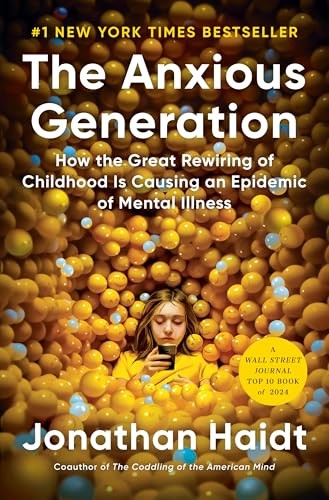
The Anxious Generation
Jonathan Haidt, 2024
The idea in one sentence: Between about 2010 and 2015 childhood moved from play to phones, and the result has been a sharp rise in anxiety and loneliness among teenagers that we can still reverse.
Haidt, a social psychologist, describes two shifts that happened together: adults became more protective in the physical world, cutting unsupervised play, and far less protective online, handing children smartphones and social media at ten or eleven. He names four harms: less time with friends in person, less sleep, fragmented attention and addictive design. Then he proposes four norms: no smartphones before secondary school, no social media before sixteen, phone-free schools, and far more independence in the real world.
The book is here because these decisions are arriving in Indian and British homes now, and the norms only work if several families in a class adopt them together, which the book makes easier to argue for.
What it gets wrong: other researchers read the same data as correlation, and Haidt is more certain than the evidence sometimes allows.
- Decide with your partner, before the request comes, the smartphone age and the social media age.
- Find two other families in your child's class and agree the same rules; one child without a phone is lonely and five is a norm.
- Give your child one new piece of real-world independence this month: walking to a shop, cooking a meal, taking a bus.
Read it if: you have a child between six and thirteen and the phone question is coming.
Skip it if: your children are grown and you want a book about your own screen habits; Deep Work and Slow Productivity do that better.

The Art of Spending Money
Morgan Housel, 2025
The idea in one sentence: There is no formula for spending well, because spending is about psychology, not maths, so the job is to understand what you are really buying and whether it is making you happier.
Housel's newest book, published in October 2025, takes the question The Psychology of Money left open: once you have some, what do you do with it? His answer is short essays rather than a budget. Much of what we buy is bought to influence what other people think of us, and those people are mostly not thinking about us at all. The spending that reliably works is on independence, time and the people you love, which rarely shows up in anyone's feed.
It is useful in 2026 because the pressure to spend visibly has never been so constant, and because many careful savers have reached the stage where frugality is its own anxiety. Housel's test, would you still buy this if nobody could see it, is one you can run in a shop.
Where it is thin: it is reflective rather than practical, some essays repeat the earlier book, and a reader in real financial trouble needs a different book first.
- Go through last month's non-essential spending and mark each item as bought for you or bought for an audience.
- Before a big purchase, ask whether it buys independence, time or relationships; if none, wait a month.
- Set a small amount you spend without guilt each month, so saving stops feeling like punishment.
Read it if: you are good at saving and bad at enjoying, or the reverse.
Skip it if: you have debt or no buffer yet; start with The Psychology of Money and come back.

Hidden Potential
Adam Grant, 2023
The idea in one sentence: Potential is not where you start but how far you travel, and the distance depends on character skills that can be learnt, not on talent you were born with.
Grant argues that we overrate early ability and underrate the habits that let people improve for decades. His character skills are specific: seek discomfort, which means speaking the language before you are ready and writing the first draft badly; be a sponge, absorbing feedback from people who are honest rather than kind; be an imperfectionist, aiming for good enough on most things so you can be excellent at the few that matter. The second part is about scaffolding: coaching, and teaching others what you have just learnt.
In 2026, when many people are being told to learn new tools or change careers in their forties, this is the book that says the ceiling is not where you think.
What it gets wrong: the stories are chosen to prove the point and the research is lighter than it looks.
- Pick a skill you gave up on and do the beginner version in public this month, badly, on purpose.
- Ask one honest person for feedback on one piece of work, and ask for advice on improving it rather than an opinion of it.
- Teach what you learnt last week to someone else; explaining it is the fastest way to find out whether you know it.
Read it if: you have told yourself you are too old, too busy or not the type.
Skip it if: you have read Mindset by Carol Dweck recently; this is the same message with more stories.

How to Win Friends and Influence People
Dale Carnegie, 1936
The idea in one sentence: People want to feel important and understood, so stop criticising, start listening, and talk about what they care about, and most of your difficult relationships become easier.
Carnegie's thirty principles are ninety years old and have outlived every communication fad since because they describe how people actually behave. Do not criticise, condemn or complain, because nobody has ever changed their mind under attack. Give honest appreciation, which is not flattery. Remember names. Ask questions and let the other person talk. When you are wrong, say so fast. Let the other person save face.
It sits at eleven because Supercommunicators now covers the same ground with better research and fewer steel magnates. But Carnegie is blunter and easier to act on, and parts one and three remain the fastest fix for a relationship that has gone stiff.
Where it is dated: the examples are from the 1930s, some advice reads as manipulation if your motives are poor, and the leadership section is padded.
- For one week, do not criticise anyone in your house or at work out loud; notice what changes in how they treat you.
- In every conversation this week, ask one more question before giving your own view.
- The next time you are wrong, say so immediately and completely, and watch the argument evaporate.
Read it if: you have a relationship at work or home that has turned into a cold war.
Skip it if: you have read Supercommunicators and apply it; Carnegie will feel like the older edition.
You can't win an argument. - Dale Carnegie
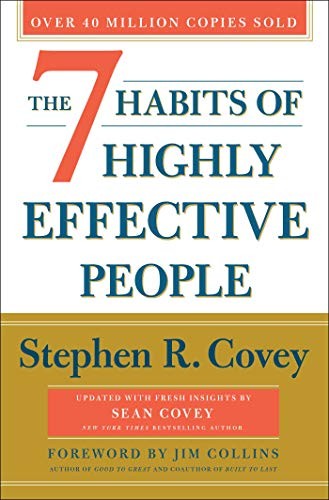
The 7 Habits of Highly Effective People
Stephen Covey, 1989
The idea in one sentence: Effectiveness grows from character rather than technique, so decide what you stand for first, then organise your week around it, and only then worry about how to work with other people.
The first three habits are private: take responsibility for your responses, decide what you want your life to add up to, and put the important ahead of the urgent. The next three are about others: look for outcomes where both sides win, understand before you try to be understood, and combine strengths. The seventh is renewal. The tool everyone keeps is the urgent-important grid from habit three, which shows that most weeks go on urgent things that do not matter while the things that would change your life, exercise, planning, a long conversation, sit untouched.
It makes this 2026 list because, in a year when tactics multiply, a framework that tells you which tactics matter is rarer than it sounds.
Where it is dated: the corporate stories run long, the language is 1980s management, and the family anecdotes can grate.
- Write a one-paragraph description of the person you want to be at the end of 2026, and reread it on the first of each month.
- Sort last week's tasks into the four quadrants and count how many hours went to important but not urgent things.
- In your next disagreement, restate the other person's position to their satisfaction before you give yours.
Read it if: you want a single map rather than a drawer of tools, and you have patience.
Skip it if: you want something to do this week; Atomic Habits and Slow Productivity get you moving faster.
Begin with the end in mind. - Stephen Covey

The Power of Now
Eckhart Tolle, 1997
The idea in one sentence: Almost all suffering comes from living in a remembered past or an imagined future, and the way out is to notice your thinking, step back from it, and attend to the only moment you actually have.
Tolle's book is spiritual in tone, but its core instruction is practical: watch the thinker. Notice the voice in your head narrating, judging and worrying, and notice that you are the one hearing it, which means you are not the voice. From there he offers tools: put attention into the body, especially the breath and hands, when the mind spins; and accept the present situation fully before deciding whether to change it.
It is on a 2026 list because the condition it describes, a mind that never lands, is now the default for anyone with a phone, and the first three chapters are still the clearest plain account of what mindfulness is for.
What it gets wrong: the language of ego and enlightenment loses practical readers, it repeats one idea for two hundred pages, and it has no plan, only a stance.
- Three times a day, stop and ask "what is my mind doing right now", then name it: planning, replaying, worrying.
- When you notice the spin, put your attention into your hands or your breath for one minute before doing anything else.
- Accept the situation in front of you for ten seconds before deciding whether to act; most reactions do not survive the pause.
Read it if: overthinking is your main problem and you are open to spiritual language.
Skip it if: jargon about ego and consciousness switches you off; the summary and a meditation app will do the same job.
Realize deeply that the present moment is all you ever have. - Eckhart Tolle

Ikigai
Héctor García and Francesc Miralles, 2016
The idea in one sentence: The long, contented lives of Okinawa's oldest residents rest on a small daily purpose, movement, close friends and eating a little less than you want, and none of it needs a system.
García and Miralles went to Ogimi, an Okinawan village with an unusual number of centenarians, and asked what the residents did. The answers are undramatic. They have a reason to get up, often a garden, a craft or a role in the community. They belong to a moai, a small group of friends who support each other for life. They stop eating at eighty per cent full, a rule called hara hachi bu.
The book is here as a short, kind counterweight to the harder titles on this list. The moai idea has grown more useful: a standing group of four or five people who actually meet is now rare enough to count as a health intervention.
Where it falls short: it is thin, it stretches a Japanese word to mean whatever the authors need, and the chapters on flow and resilience are borrowed from other books.
- Name one small thing you look forward to doing each morning, and protect it before the phone comes on.
- Pick four or five people and set up a standing monthly meal; that is a moai, and it is the hardest habit on this page to start.
- Stop eating when you are nearly, not completely, full for one week and notice the afternoons.
Read it if: you want a gentle reset and three hours is all you have.
Skip it if: you want evidence and a programme; Outlive is the serious book on the same subject.

Can't Hurt Me
David Goggins, 2018
The idea in one sentence: Most people stop at about forty per cent of what they can do, and the way to find the rest is to go towards discomfort deliberately and keep a record of every time you did.
The memoir half, an abusive childhood, obesity, then Navy SEAL training and ultramarathons, is remarkable and is why people finish the book. The challenges are the usable part. The accountability mirror: write your real situation and your next step on a note and put it where you brush your teeth. The cookie jar: keep a list of the hard things you have already done and reread it when you want to quit. The forty per cent rule: when your mind says stop, you are usually less than half done.
It sits at fifteen because it is the least general book here. The tone is relentless, and a parent who has slept five hours does not need to be told to suffer more. But for someone with a single hard goal who knows the problem is flinching, two of the challenges work better than anything gentler.
What it gets wrong: much of it should not be copied, the injuries are a warning rather than a model, and the self-talk tips into contempt for other people in places.
- Write the uncomfortable truth about your goal and one next step on a note by the mirror, and update it weekly.
- Start a cookie jar: a list on your phone of every hard thing you have done, read when you want to quit.
- Pick one small daily discomfort, a cold shower, the stairs, the difficult email first, and do it for thirty days.
Read it if: you have one hard goal, know exactly what stops you, and want a harder voice than your own.
Skip it if: you are already running on empty; this book is fuel for people who have some, not a cure for burnout.
Which book should you read first in 2026?
- If your year needs a change that sticks past January, start with Atomic Habits, because the two-minute rule and habit stacking survive bad weeks.
- If your year needs less money worry, start with The Psychology of Money, because it fixes the behaviour before you touch a single product.
- If your year needs you to stop being busy and start finishing things, start with Slow Productivity, because a project cap and visible reply rules do not depend on your employer changing.
- If your year needs a relationship repaired, start with Supercommunicators, because the three-conversations test can be used tonight.
- If your year needs you to be stronger at sixty than you are now, start with Outlive, because the exercise chapters give you the targets and every year you wait makes them harder to hit.
- If your year needs you to care less about what other people do, start with The Let Them Theory, because a two-word phrase is the only tool here you can use in the middle of an argument.
A reading plan for 2026: one book a month
Twelve months, twelve books, in an order that builds: habits and money first because everything else depends on them, then work and relationships, then health and children, with a deliberately light December. The three left out, The 7 Habits, The Power of Now and Can't Hurt Me, are for readers whose situation matches them.
| Month | Book | Why now |
|---|---|---|
| January | Atomic Habits | Resolutions are two weeks old and wobbling; this is the book that steadies them. |
| February | The Psychology of Money | Before the tax year ends, fix the behaviour, then sort the products. |
| March | Slow Productivity | By now work has filled every gap; cap your projects before the second quarter. |
| April | Supercommunicators | A long weekend with family is the best test of the three-conversations idea. |
| May | Deep Work | With the project cap in place, build one defended block a day for the hard work. |
| June | The Let Them Theory | Mid-year is when other people's plans and opinions pile up; practise letting them. |
| July | Outlive | Summer is the easiest time to start the steady cardio the book asks for. |
| August | The Anxious Generation | Read it before the new school year, while the phone rules can still be set. |
| September | Hidden Potential | New term, new skill; pick the one you gave up on and start badly. |
| October | The Art of Spending Money | Before the festival and Christmas spending, decide what you are actually buying. |
| November | How to Win Friends and Influence People | The season of family gatherings and work reviews; Carnegie smooths both. |
| December | Ikigai | A short, kind book for a quiet week, and a reminder of what the year was for. |
Read next
Questions people ask
What are the best books to read in 2026?
For non-fiction, the fifteen above, led by Atomic Habits, The Psychology of Money and Slow Productivity. The strongest recent titles are Supercommunicators, The Let Them Theory, Outlive, The Anxious Generation and Morgan Housel's The Art of Spending Money, published in late 2025. If you want fiction, this is the wrong list; we only rank books we have read in full and tested.
What book should everyone read in 2026?
Atomic Habits. Not because it is new, but because almost everything people want from 2026, better money, better health, less phone, needs a habit to carry it, and this is the book that explains how habits form and fail. If you have read it, the answer is Slow Productivity, which describes the shape of work in 2026 more accurately than anything else so far.
What are the best self-improvement books in 2026?
The new ones worth your time are Slow Productivity for work, Supercommunicators for conversations, The Let Them Theory for stress about other people and Hidden Potential for learning something late. Among the classics, Atomic Habits, The 7 Habits and How to Win Friends and Influence People still outperform most of last year's releases. Read two or three; after that the genre repeats itself.
How many books should I read in a year?
Twelve is a fair target for someone with a job and children: one book a month, twenty minutes a day, which is roughly the reading plan above. Most adults read far fewer, so twelve already puts you ahead. The number matters less than finishing and using what you read. One book applied for a month beats five skimmed, and a six-minute summary covers the books you only need the idea from.
What is the most popular book right now?
Popularity charts in 2026 are dominated by fiction, mostly thrillers and romance, and change every week. In non-fiction, Atomic Habits has stayed near the top for years, The Let Them Theory was the biggest self-help book of 2025, and The Psychology of Money and The Anxious Generation sell steadily. Popular and useful overlap less than you would hope, which is why this list is ranked by usefulness.
What is the best book to start reading again?
Pick something short, practical and immediately useful, because the first book back has to be finished. Ikigai at 208 pages takes about three hours and asks nothing of you. The Psychology of Money has twenty stand-alone chapters, so you can stop and start without losing the thread. Set a rule of ten pages a day, read on paper rather than a phone, and do not pick up a 500-page book until the habit is back.
Books in this article
Atomic Habits
Small habits, repeated daily, compound into big results. Build them with four simple laws.
The Psychology of Money
Doing well with money is about behaviour, not intelligence: luck, enough, time, and freedom.
Deep Work
Four hours of real concentration beat ten hours of busy work. Protect them with rituals and a hard stop.
Ikigai
What the hundred-year-olds of Okinawa do: a reason to get up, a tribe, light eating, flow, gentle daily movement.
Can't Hurt Me
You quit at 40 percent of what you can do. Callous the mind with voluntary hardship, keep an accountability mirror, and take souls.