Best-of list · Money and Personal Finance
Best Personal Finance Books: 12 That Actually Change What You Do With Money
The best personal finance book for most people is The Psychology of Money by Morgan Housel, because nearly every money problem is a behaviour problem, and this is the only book on the list that starts there instead of with a spreadsheet. We built this list of the best personal finance books by reading each one in full and then checking one thing a month later: what did we actually do differently with our money? Books that produced a standing order, a cancelled policy or a cheaper fund ranked high. Books that produced a warm feeling and nothing else ranked low. One book is written for Indian readers, because the American classics cannot tell you what to do with an EPF or a ULIP.
Quick picks
| Rank | Book | Best for | Pages | Verdict |
|---|---|---|---|---|
| 1 | The Psychology of Money, Morgan Housel | Understanding why you do what you do with money | 256 | Read it |
| 2 | I Will Teach You to Be Rich, Ramit Sethi | Setting up accounts and automating in six weeks | 352 | Read it, adapt the US parts |
| 3 | The Simple Path to Wealth, JL Collins | A whole investing plan on one page | 286 | Read the first half |
| 4 | Your Money or Your Life, Vicki Robin and Joe Dominguez | Working out what you are trading your life for | 368 | Read steps 1 to 4, skim the rest |
| 5 | The Millionaire Next Door, Thomas Stanley and William Danko | Realising wealth is not what it looks like | 272 | Read the first third |
| 6 | The Little Book of Common Sense Investing, John C. Bogle | Why costs decide your returns | 304 | Read it once |
| 7 | Let's Talk Money, Monika Halan | Indian readers who need the actual steps | 204 | Read it, do the money box |
| 8 | The Richest Man in Babylon, George S. Clason | A first money book, or a gift | 144 | Read it in an evening |
| 9 | Die With Zero, Bill Perkins | Savers who have forgotten why they save | 240 | Read it, argue with it |
| 10 | Rich Dad Poor Dad, Robert Kiyosaki | The asset-and-liability mindset, nothing else | 336 | Summary is enough |
| 11 | The Intelligent Investor, Benjamin Graham | Patient readers who want to understand markets | 640 | Read chapters 8 and 20 |
| 12 | Think and Grow Rich, Napoleon Hill | Motivation, if you know that is all it is | 238 | Summary is enough |
How we ranked the best personal finance books
Most lists of money books are ordered by sales or by how often other lists mention them, which is how a book with a disputed backstory and a bankrupt publishing company ends up at number one on half the internet. We ordered ours by what changed after reading, judged on three questions.
- Did the book lead to a concrete action within a month: a transfer set up, a policy swapped, a fund fee checked? If it produced only a mood, it ranked lower.
- Does the advice survive a real household: one or two salaries, children, a home loan, parents to support? Books written for traders or people with no dependants ranked lower.
- Is the book honest about what it does not know? Books that promise certainty, hide the author's luck or sell a course in the final chapter lost marks.

The Psychology of Money
Morgan Housel, 2020
The idea in one sentence: Doing well with money depends far more on behaviour than on intelligence, so learn the handful of habits that stop ordinary people getting in their own way.
Housel's book is twenty short chapters, each built around one idea and one story. Getting wealthy and staying wealthy need opposite skills, optimism for the first and paranoia for the second. And wealth is the money you did not spend, which is why it is invisible and why the man in the expensive car usually does not have it.
Compounding only works if you stay invested for decades, so the whole game is a plan you will not abandon in a bad year, which means holding more cash than a spreadsheet says. The everyday example is the couple who sold their funds in March 2020 and bought back a year later at a higher price, because they could not sleep.
Where it is weak: it is a book of principles, not steps, so you will still need another book to tell you which account to open. The final chapter, where Housel explains his own portfolio, is the most useful ten pages in the genre.
- Keep enough cash that a bad year never forces you to sell.
- Define "enough" in writing before a pay rise moves the line.
- Judge yourself by the quality of your decisions, not by whether they happened to work.
Read it if: you have read money advice before, never followed it, and want to know why.
Skip it if: you need account-by-account instructions this weekend; read Sethi or Halan first and come back.
Wealth is what you don't see. - Morgan Housel
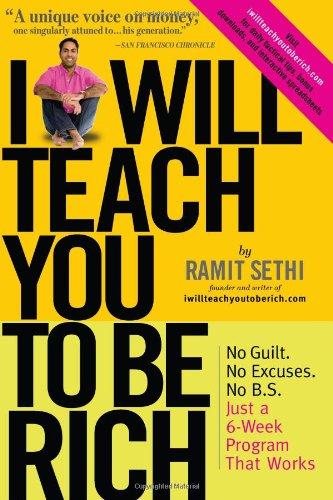
I Will Teach You to Be Rich
Ramit Sethi, 2009
The idea in one sentence: Spend a few hours once to automate your accounts, then spend freely on the things you love and cut without mercy on the things you do not.
Sethi's book is a six-week programme: sort out credit cards and bank accounts, open investment accounts, then write a conscious spending plan with four buckets: fixed costs around 50 to 60 per cent of take-home pay, investments around 10, savings 5 to 10, and guilt-free spending with the rest. The last two weeks automate every transfer to leave on payday and put the investments into low-cost index funds, then ignore them.
Sethi has no patience for latte maths and argues that a hundred small sacrifices matter less than getting five big things right: salary, automatic investing, fees, debt and the house decision.
Where it is weak: it is written for an American with a 401(k) and a credit score, and the tone is a loud friend who is sometimes right at your expense. The structure, automate first and spend guilt-free after, needs no translation.
- On your next payday, set up automatic transfers to savings and investments that leave before you see the money.
- Write a conscious spending plan with four buckets and stop tracking individual coffees.
- Spend without guilt on the two or three things you love; cut the things you do not notice.
Read it if: you have never set up your accounts properly and want a weekend project that fixes it.
Skip it if: your accounts are already automated; this book stops where investing begins.

The Simple Path to Wealth
JL Collins, 2016
The idea in one sentence: Spend less than you earn, put the difference into one broad, low-cost index fund, avoid debt, and never sell when the market falls.
The book began as letters Collins wrote to his daughter, who found money boring and wanted to be told what to do once. The core is a single total stock market index fund, bought every month regardless of headlines, with bonds added as you approach the point where you live off the money. Several chapters explain why markets always recover, why nobody can time them, and why the person who panics and sells is the one who loses.
The idea most readers keep is "F-you money": a sum large enough that you can leave a bad job or a bad city without fear.
Where it is weak: the fund recommendations are American, the 4 per cent withdrawal rule needs adjusting for local inflation and tax, and the second half repeats the first. Read it for the mindset, then find the local equivalent of the fund.
- Choose one broad, low-cost index fund and set up a monthly purchase you never pause.
- Decide now what you will do when the market falls 30 per cent: nothing. Keep buying.
- Name the sum that would let you walk out of a job and track it.
Read it if: you want investing explained once, simply, by someone with nothing to sell.
Skip it if: you enjoy picking stocks and want permission; Collins will spend 200 pages telling you to stop.
Spend less than you earn, invest the surplus, avoid debt. - JL Collins

Your Money or Your Life
Vicki Robin and Joe Dominguez, 1992
The idea in one sentence: Money is the life energy you traded hours for, so measure every purchase in hours worked and stop buying things that do not return the time.
Robin and Dominguez wrote the book that started the financial independence movement. Their nine steps begin with an honest accounting: work out how much you have earned in your whole life and what you have to show for it, then calculate your real hourly wage after commuting, work clothes, decompression and the takeaways you buy because you are too tired to cook. Most people find the real figure is half the nominal one.
The middle steps are tracking every rupee and asking of each category whether the fulfilment matched the hours, whether it fits your values, and whether it would change if you did not have to work. The last steps cover the crossover point, where investment income meets expenses.
Where it is weak: the investment chapters were written for an era of 8 per cent government bonds, and the tone can be preachy. Steps 1 to 4 alone change how people spend for years.
- Calculate your real hourly wage after every work-related cost, and price your next big purchase in hours.
- Track every spend for one month and ask of each category whether the fulfilment matched the life energy.
- Work out your crossover point and treat it as the actual retirement date.
Read it if: you earn a decent salary, spend most of it and feel no richer than five years ago.
Skip it if: your income barely covers essentials; the book assumes there is spending to question.
Money is something we choose to trade our life energy for. - Vicki Robin
The Millionaire Next Door
Thomas Stanley and William Danko, 1996
The idea in one sentence: Most people with real wealth live modestly, drive ordinary cars and save relentlessly, while most people who look rich are spending their way towards nothing.
Stanley and Danko spent two decades surveying American millionaires and found that the typical one did not look the part: middle-class neighbourhood, used car, one marriage, an unglamorous business, and a large share of income saved for decades. Their central distinction is between prodigious accumulators of wealth, who have far more net worth than their income and age predict, and under-accumulators, who earn well and own little.
The chapter that lands hardest is on economic outpatient care, the money affluent parents give adult children, which the authors found made those children less wealthy because it funded a lifestyle rather than a habit. The everyday example is two neighbours on the same salary: one with the new SUV and the premium school, one with a ten-year-old car and a portfolio that could already pay for both.
Where it is weak: the data is thirty years old and American, the sample only includes people who had already become wealthy, and the frugality can tip into joylessness, which is why Die With Zero is on this list as a corrective. The core finding still holds.
- Calculate your net worth tonight and compare it to one tenth of your age multiplied by your income.
- Notice for a month which purchases are for use and which are for display, and cut one from the second list.
- If you give adult children money, give it for assets or skills, never for a lifestyle.
Read it if: you earn well, have little to show for it and suspect your neighbours are the reason.
Skip it if: you already live below your means and track net worth; the rest is case studies.
Wealth is not the same as income. - Thomas Stanley and William Danko

The Little Book of Common Sense Investing
John C. Bogle, 2007
The idea in one sentence: Over time almost no fund manager beats the market after costs, so own the whole market through a low-cost index fund and keep what the fees would have taken.
Bogle founded Vanguard and launched the first index fund for ordinary investors in 1976, and this short book is his argument compressed. All investors together earn the market return, so after costs they earn less than the market, and the more a fund charges the further below it its investors land. An expense ratio of 2 per cent, normal for an actively managed fund, consumes well over half of a lifetime's returns through what he calls the tyranny of compounding costs.
Funds that beat the market in one decade mostly fall behind in the next, so picking a manager on their record is a lottery ticket with a fee. The everyday example is the parent paying 2.5 per cent a year on a plan sold by a relationship manager, who would have twice the final sum in a fund charging 0.2.
Where it is weak: it is American, it repeats itself, and Bogle's grudge against the fund industry sometimes crowds out the steps. Indian readers should check that local index funds have low costs and tracking error, which they increasingly do.
- Find the expense ratio of every fund and policy you hold; anything above 1 per cent needs a reason to stay.
- Move new money into a broad, low-cost index fund and let the active funds run down.
- Ignore last year's best performing fund; the record tells you almost nothing about next year.
Read it if: you invest through an adviser, a bank or an app and have never asked what the fund costs.
Skip it if: you already hold index funds and know why; Bogle will spend 300 pages agreeing with you.
Don't look for the needle in the haystack. Just buy the haystack! - John C. Bogle

Let's Talk Money
Monika Halan, 2018
The idea in one sentence: Set up three bank accounts, buy the right insurance before any investment, build an emergency fund, then invest through mutual funds in a system that runs itself.
Halan is a financial journalist who spent two decades watching Indian households get sold the wrong products. The centrepiece is the money box: a salary account that receives income, a spend-it account that gets a fixed monthly transfer for living costs, and an invest-it account that takes the rest. She insists on an emergency fund first, then family medical cover, then a plain term life policy priced on income. Only then does investing begin, through equity mutual funds for long goals and debt funds or deposits for short ones.
The most valuable pages are the ones saying no. No to endowment policies that mix insurance with poor returns, to ULIPs sold by relatives, to gold and property as the whole plan. The everyday example is the thirty-year-old with four insurance policies, no term cover, a locked-in ULIP and no emergency fund.
Where it is weak: it is tied to Indian products, so readers elsewhere will find little, and it covers investing in less depth than the American books above. Some details have dated since 2018, which is why a third edition exists.
- Open the three accounts this month and set a fixed transfer to the spend-it account on salary day.
- Before any new investment, check you have an emergency fund, health cover and a term plan; if not, those come first.
- List every insurance policy you own and stop the ones that are really bad investments.
Read it if: you are a salaried Indian with a few policies you do not understand and savings sitting in a bank account.
Skip it if: you live outside India; the structure is sound but every product reference will need translating.

The Richest Man in Babylon
George S. Clason, 1926
The idea in one sentence: Keep a tenth of everything you earn, control your spending, make the saved money work, and never put it into things you do not understand.
Clason wrote these as pamphlets for banks to hand out in the 1920s, and they are parables set in ancient Babylon: Arkad the richest man explains how he got there and a slave buys his freedom. The advice inside is a complete beginner's course. Pay yourself first, at least a tenth. Budget the rest. Invest with people who know what they are doing. Protect the principal. Provide for old age. Keep improving your ability to earn.
The format is why it still works: a rule a character learns by losing his savings to a brickmaker who claimed to know about jewels is remembered.
Where it is weak: the advice on gold and lending is a century old, and there is nothing on inflation, tax, insurance or any modern instrument. Read it for the habits, then move to Halan or Sethi for the mechanics.
- Set a transfer of 10 per cent of income to savings on the day you are paid, before any spending.
- Never invest in something because a friend is enthusiastic; ask whether they, or you, understand it.
- Spend a little each month on getting better at your work; earning more is the lever.
Read it if: you want the fundamentals in an evening, or you are buying a money book for someone young.
Skip it if: you already save automatically and want to know what to do next; this book stops at the basics.
A part of all you earn is yours to keep. - George S. Clason
Die With Zero
Bill Perkins, 2020
The idea in one sentence: Experiences pay a dividend in memories for the rest of your life, so spend while you are healthy enough to enjoy them and aim to run out of money at the end rather than die on a pile of it.
Perkins, a former energy trader, argues that most money advice optimises for the wrong failure. People are terrified of running out, so they over-save, then reach seventy with health that limits what they can do and a sum they will never spend. His tools: time buckets, where you divide your remaining life into five-year blocks and list what belongs in each, because a mountain trek belongs in your forties; the memory dividend, where an experience at thirty pays out every time you recall it; and giving while alive, since money for children is most useful when they are 26 to 35 and need a deposit.
The everyday example is the parent who skipped the family trip every year for the retirement fund and found at 68 that the children were grown and the knees were gone.
Where it is weak: the author is rich, and parts read like a wealthy man's hobby. The advice assumes good health, a stable income and a safety net most readers do not have, and taken literally it is dangerous for anyone without a pension. Read it as a corrective to the frugality books above, not as a plan.
- Write your time buckets: five-year blocks from now to 80, with the experiences that belong in each.
- Pick one experience you keep postponing for money reasons, cost it honestly, and book it this year.
- If you plan to leave money to children, work out what portion could help them now.
Read it if: you save well, feel vaguely guilty about every holiday and cannot say what the money is for.
Skip it if: you have no emergency fund or pension; this book is for a problem you do not yet have.

Rich Dad Poor Dad
Robert Kiyosaki, 1997
The idea in one sentence: The poor and middle class work for money and buy liabilities they think are assets, while the rich buy assets that produce income and let the money work for them.
Kiyosaki tells the story of two fathers: his own, an educated teacher who struggled with money, and his friend's, a businessman who taught the boys how the rich think. An asset puts money in your pocket; a liability takes it out. Your house is a liability by that definition, because it costs you every month. Salary is taxed before you see it and never makes you rich on its own.
That distinction has done more to make ordinary people look at their balance sheet than any textbook, and it is why the book sits on this list at all.
Where it is weak is where most of the book is. Rich Dad has never been identified and may be an invention, Kiyosaki's company Rich Global LLC filed for bankruptcy in 2012, and the book funnels readers towards expensive seminars. The advice is vague where it counts, dismissive of index investing, and casual about borrowing to buy property, which ruined people who read it in 2007. Our summary gives you the idea without the sales pitch.
- List everything you own and owe, and sort each item by whether it puts money in your pocket or takes it out.
- Treat your home as a cost of living, not an investment, when deciding how much to borrow for it.
- Stop reading when the book moves from mindset to method.
Read it if: you have never thought of your finances as a balance sheet and want a vivid push to start.
Skip it if: you already know the difference between an asset and a liability; the rest is thinner and some of it is harmful.
The rich don't work for money. - Robert Kiyosaki

The Intelligent Investor
Benjamin Graham, 1949
The idea in one sentence: The market is a moody business partner who offers you prices every day, and your job is to buy only when the price is well below value, with a margin of safety for your own mistakes.
Graham was Warren Buffett's teacher, and this is the book Buffett has repeatedly called the best on investing. Two ideas carry it. Mr Market is the imaginary partner who turns up each day offering to buy your shares or sell you his at a price that swings with his mood; you are free to ignore him, because price is what he says and value is what the business is worth. The margin of safety means buying only when the price is so far below your estimate of value that being wrong will not hurt you.
Graham also separates the defensive investor, who wants a sound return with little effort and should hold a simple mix of broad funds and bonds, from the enterprising investor, who is willing to do real work.
Where it is weak: it is long, dense and full of 1970s examples, and Zweig's commentary doubles the page count. Read the introduction and chapters 8 and 20, which hold Mr Market and the margin of safety, and keep the rest for the day you want to value a company.
- Decide whether you are a defensive or an enterprising investor; if you will not spend hours on it, you are defensive.
- Before buying anything, write down what you think it is worth and why; if you cannot, you are speculating.
- Treat market swings as prices offered, not verdicts delivered.
Read it if: you want to understand investing from its foundations and have the patience for a long book.
Skip it if: you want a plan this month; Bogle and Collins give you Graham's conclusions in a tenth of the pages.
The investor's chief problem, and even his worst enemy, is likely to be himself. - Benjamin Graham

Think and Grow Rich
Napoleon Hill, 1937
The idea in one sentence: Wealth starts with a definite desire, a plan, persistence and the right people around you, and the mind you train is the mind that gets rich.
Hill's thirteen principles, from desire and faith to persistence and the mastermind, are the ancestors of every success book since. Strip away the mystical parts and a few are plain good sense. Write down exactly what you want and by when. Change the plan rather than the goal when it fails. Surround yourself with people who know what you do not. Keep going when most people would stop.
Where it is weak is nearly everywhere else. Hill's claim that Andrew Carnegie commissioned the work has never been verified, and the chapters on the subconscious and the sixth sense are not advice anyone should follow with money. There is nothing here on saving, investing, insurance or debt; our summary gives you everything worth keeping.
- Write one specific financial goal with a number and a date, and read it every morning for a month.
- When a plan fails, replace the plan and keep the goal; most people do the reverse.
- Find two or three people who know more than you about money and talk to them regularly.
Read it if: you need a kick to decide what you actually want and can read past the mysticism.
Skip it if: you want advice about money; this book has none, and the books above have plenty.
Whatever the mind of man can conceive and believe, it can achieve. - Napoleon Hill
Which money book should you read first?
- If you know what to do with money and never do it, start with The Psychology of Money, because it explains the behaviour underneath every money mistake.
- If your accounts are a mess and nothing is automated, start with I Will Teach You to Be Rich, because its six-week programme sets everything up once.
- If investing feels like a foreign language, start with The Simple Path to Wealth, then The Little Book of Common Sense Investing, because together they give you one fund, one habit and one rule about costs.
- If you are in India and want the actual steps with the actual products, start with Let's Talk Money, because it is the only book here that knows what an ELSS or a term plan is.
- If you earn well and feel no richer, start with Your Money or Your Life, because the real hourly wage calculation changes how you see every purchase.
- If you save well and enjoy none of it, start with Die With Zero, because it is the only book on the list that asks what the money is for.
Money books that are overrated
The Total Money Makeover by Dave Ramsey has helped a great many people out of debt, and the debt snowball, paying the smallest balance first for the motivation, is a sound behavioural trick. But the book is built around American church culture, a hostility to all borrowing including sensible home loans, and investment assumptions of 12 per cent a year that nobody should plan on. The first third is useful if you are drowning in consumer debt. The rest is a sermon.
Rich Dad Poor Dad appears on this list at ten and here as well, because its reputation as the finance book is out of all proportion to its content. One good distinction, assets against liabilities, is wrapped in an unverifiable story, a dislike of ordinary saving and a sales funnel. Read our summary, keep the one idea, and spend the time you save on Bogle.
The 4-Hour Workweek by Tim Ferriss is often shelved with money books and is not one. It is about escaping employment through automation, outsourcing and a product that sells while you sleep, which worked for a single man with a supplements business in 2007 and is a weaker fit for a parent with a home loan. As a financial plan it is a lottery ticket described as a system.
Read next
Questions people ask
What is the best personal finance book for beginners?
The Psychology of Money to understand your own behaviour first, I Will Teach You to Be Rich to get your accounts set up this month, and The Richest Man in Babylon for the basics in two hours. Indian beginners should start with Let's Talk Money, which covers the actual products.
What is the number one finance book?
By sales, Rich Dad Poor Dad, with tens of millions of copies. By usefulness, The Psychology of Money, the most recommended money book of the past five years for good reason: short, honest about luck, and built around habits that survive bad years.
What is the best book to learn about money?
For how money works in a household, Your Money or Your Life and I Will Teach You to Be Rich. For how markets and funds work, The Little Book of Common Sense Investing and then The Intelligent Investor. For how people behave with money, The Psychology of Money. Read one from each group and you will know more than most people selling you products.
Which book should I read first about investing?
The Simple Path to Wealth, because it gives you a complete plan in plain language: one broad index fund, bought monthly, never sold in a panic. Follow it with The Little Book of Common Sense Investing for why costs matter. Leave The Intelligent Investor until you want to understand valuation; it is a better third book than first.
What are the best personal finance books for Indians?
Let's Talk Money by Monika Halan is the essential one, because it covers EPF, PPF, term insurance, health cover, mutual funds and SIPs in the order a salaried person should tackle them. Pair it with The Psychology of Money for behaviour and The Little Book of Common Sense Investing for why low-cost funds beat the plans your bank sells.
Are personal finance books worth reading?
Three or four of them, yes, and then stop. The field has a handful of real ideas: spend less than you earn, automate it, buy insurance before investments, hold low-cost diversified funds for decades, and leave them alone in a crash. Once a book has made you act on those, the next one is entertainment.
Books in this article
The Psychology of Money
Doing well with money is about behaviour, not intelligence: luck, enough, time, and freedom.
Rich Dad Poor Dad
Buy things that pay you; stop buying things that cost you. Everything else in the book is a story.
Think and Grow Rich
A definite goal, a written plan, daily repetition and a mastermind group. Four useful ideas wrapped in 1937 mysticism.