Best-of list · Psychology and Mindset
Best Self Improvement Books: 12 for Real Personal Growth, Honestly Ranked
The best self improvement book for most people is Atomic Habits by James Clear, because personal growth is not a feeling you get from a book but a thing you do on Tuesday, and this is the only book in the genre built entirely around how to keep doing it. This list of the best self improvement books treats self improvement as skills and growth, which means learning, thinking, communication, health and career, rather than mood and therapy, which we cover in our best self-help books list. Every chapter of every book was asked one question: does this still help when you have a job, children and a phone that never stops? Books that need a sabbatical, a personal assistant or a personality transplant ranked lower, however many copies they sold. Where a six-minute summary gives you everything the book does, we say so, because your time is the point.
Quick picks
| Rank | Book | Best for | Pages | Verdict |
|---|---|---|---|---|
| 1 | Atomic Habits, James Clear | Making any improvement stick | 320 | Read it |
| 2 | Supercommunicators, Charles Duhigg | Conversations that go wrong at home and work | 320 | Read it |
| 3 | Deep Work, Cal Newport | Doing work that needs thought | 304 | Read the first half, adapt the second |
| 4 | Essentialism, Greg McKeown | Too many commitments, none of them chosen | 272 | Read it |
| 5 | Never Split the Difference, Chris Voss | Asking for things and getting them | 288 | Read it, skip the hostage stories if short of time |
| 6 | Ultralearning, Scott Young | Learning a new skill as an adult | 304 | Read it, with a project in mind |
| 7 | Thinking, Fast and Slow, Daniel Kahneman | Understanding why you make bad decisions | 499 | Read parts 1 to 3, summary for the rest |
| 8 | So Good They Can't Ignore You, Cal Newport | Career choices and the passion trap | 304 | Read it once |
| 9 | Hidden Potential, Adam Grant | Anyone who thinks they started too late | 304 | Read it |
| 10 | Outlive, Peter Attia | Health for the next forty years | 496 | Read the exercise chapters, skim the medicine |
| 11 | The 7 Habits of Highly Effective People, Stephen Covey | One framework for character and work | 381 | Read habits 1, 2 and 5 |
| 12 | Think and Grow Rich, Napoleon Hill | Goal setting, if you can filter the mysticism | 320 | Summary is enough |
How we ranked the best self improvement books
Most lists of the best self improvement books are ordered by sales, by fame or by what the writer happened to read at twenty-two. We ordered ours by how much of the advice is still in use after a normal week for an adult with a job, a household and a phone. Each book was read cover to cover, the central method was tried for at least two weeks, and the book was then scored on three questions.
- Does the advice survive a real week, with interruptions, tiredness and other people, or does it only work for someone who controls their own calendar?
- Does the book rest on more than the author's own story? Research, long professional practice or a method other people have tested ranked higher than one dramatic turnaround.
- How much of the book does a good summary replace? If the whole idea fits on a page, we say so and rank the book lower, however good the page.

Atomic Habits
James Clear, 2018
The idea in one sentence: Improvement comes from systems rather than goals, so make each new behaviour tiny, attach it to something you already do, and arrange your surroundings so the better choice is the easier one.
Every other book on this list asks you to do something new, and none spends more than a paragraph on how you keep doing it after the novelty wears off. Clear's book is entirely about that gap. His four laws, make it obvious, attractive, easy and satisfying, each come with a tool you can use tonight, and the two-minute rule shrinks a habit until "learn Spanish" becomes "open the app and do one card".
The chapter that matters most for personal growth is the one on identity. Lasting change starts with deciding who you are, not what you want, and each small action is a vote for that person. The parent who wants to read more decides she is a reader, puts a book on the pillow and reads two pages at night.
Where it is weak: it is long for its content, the business stories are padding, and it says little about which habits are worth building, which is what the rest of this list is for.
- Shrink any new behaviour to under two minutes and do only that for a fortnight.
- Write every habit as "after I do X, I will do Y", tied to a fixed point in your day.
- Put what you want to do where you can see it and what you want to stop out of reach; willpower is a poor plan.
Read it if: you have started the same improvement three times and want the fourth to be the last.
Skip it if: you already run a habit system that works; the book will confirm it, not change it.
Habits are the compound interest of self-improvement. - James Clear

Supercommunicators
Charles Duhigg, 2024
The idea in one sentence: Most conversations fail because the two people are having different kinds of conversation, practical, emotional or social, and the skill is to notice which one is happening and match it before trying to be understood.
Communication is the self improvement skill with the highest return, because you use it fifty times a day, and this is the best recent book on it. Duhigg's idea is that every discussion is really one of three: what is this about (a problem to solve), how do we feel (an emotional exchange) and who are we (a conversation about identity). The classic failure is one person offering solutions while the other wanted to be heard.
At the end of a working day, one partner describes a terrible meeting and the other says "you should talk to HR". That is a practical reply to an emotional conversation, and it lands as dismissal. Duhigg's fix is to ask whether they want help, want to be heard or want a distraction, and then give that.
Why it is here rather than How to Win Friends and Influence People: Carnegie's book, on our self-help list, is the better guide to being liked; Duhigg's is the better guide to being understood. Where it falls short: the case studies run long and the chapters on online conversation are thin.
- Before replying to anything emotional, ask "do you want me to help, to listen, or to take your mind off it".
- Match the conversation you are in: solve problems in practical talks, name feelings in emotional ones.
- Replace one factual question a day with a deep one: not "how was school" but "what was the best bit of today".
Read it if: you are often right and still lose the argument, or the people you love say you do not listen.
Skip it if: you have done a counselling or coaching course; the model will be familiar in different words.

Deep Work
Cal Newport, 2016
The idea in one sentence: The ability to concentrate on one hard thing for a sustained stretch is a skill, modern work has let it rot, and the people who rebuild it, even for an hour a day, learn faster and produce more.
Every skill on this list is learnt faster with undivided attention, and almost nobody has any. Newport splits work into deep (hard, valuable, needs full focus) and shallow (email, chat, meetings that could be a message). His most useful idea is attention residue: every "quick check" of the phone leaves part of your mind on the phone for the next twenty minutes, which is why a day of checking ends tired and unfinished.
The philosophy holds up completely; the tactics, with their academics who vanish into cabins, need translating for a life with a school run. Translated, it becomes one protected block a day, the phone in another room, and a shutdown ritual so work stops following you to the dinner table.
Why third rather than first: the book assumes you own a chunk of your calendar, and anyone in a reactive job or caring for small children owns less than they would like.
- Book one block a day, even 30 minutes, for the task that needs most thought, and treat it like an appointment.
- Keep the phone in another room during the block; a glance costs far more than a glance.
- End the day with a two-minute shutdown: list what is open, note tomorrow's first task, and stop.
Read it if: your work needs thought and you cannot remember the last time you did an hour of it without interruption.
Skip it if: your job is reactive by design, or you already guard a daily focus block; the second half will only frustrate you.
Clarity about what matters provides clarity about what does not. - Cal Newport
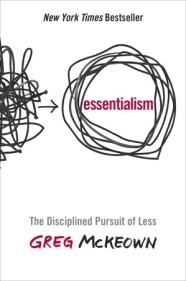
Essentialism
Greg McKeown, 2014
The idea in one sentence: Almost everything is noise, a few things matter enormously, and the discipline of personal growth is to work out which is which and then say no to the rest, politely and often.
Most self improvement advice adds things to your life; McKeown's book is about subtraction, and for a busy adult that is often where the real growth is. If you do not decide what matters, other people's priorities fill the space, and his test is severe: if a commitment is not a clear yes, it is a no. He covers how to say no without burning a relationship, and why "I have to" is nearly always "I have chosen to and would rather not admit it".
The everyday example is the parent who is on the school committee, runs the office birthday fund, mentors two juniors and has not exercised since March. None of those was a decision; each was a request answered on a tired afternoon. McKeown's method is to list every standing commitment, score it out of ten, and treat anything under a nine as a candidate for a graceful exit.
Where it falls short: it is repetitive and the examples lean towards executives who can delegate. But choosing on purpose survives any week, and you cannot learn, focus or exercise in time you have given away.
- Score every regular commitment out of ten; anything under nine goes on a "leave gracefully" list.
- Answer every new request with "let me check and come back to you", and decide in the morning.
- Add a 20 per cent buffer to every time estimate, because the week never goes to plan.
Read it if: you are competent, busy, trusted with everything, and quietly resentful about it.
Skip it if: you already say no easily; read Four Thousand Weeks instead for what the time is for.
If you don't prioritize your life, someone else will. - Greg McKeown
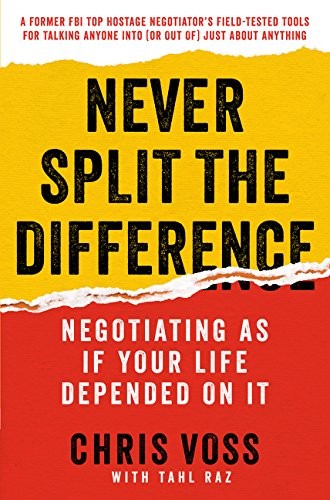
Never Split the Difference
Chris Voss, 2016
The idea in one sentence: Negotiation is not logic but emotion, so the way to get what you want is to make the other person feel understood, using a few simple verbal tools, before you ask for anything.
Voss was the FBI's lead international kidnapping negotiator, and the surprise of his book is how much of it works at a kitchen table. Mirroring is repeating the last few words someone said, which makes them keep talking. Labelling is naming their emotion out loud, "it sounds like you feel this was unfair", which takes the heat out of it. Calibrated questions, usually starting with "how" or "what", make the other person solve your problem: "how am I supposed to do that" is more powerful than "no".
The parent who says "it sounds like you are really not ready to stop playing" and then asks "how can we make sure you still get your story" gets a better result than the parent who repeats the instruction louder.
Why fifth: these are skills, and skills take practice, which is why we say read it rather than summarise it. The hostage stories run long, the tone sometimes swaggers, and the first two-thirds hold all the gold.
- When someone is heated, label the feeling out loud, "it seems like you are frustrated", and then stay quiet.
- Replace "no" with a question that starts with "how": "how am I supposed to do that by Friday".
- Repeat the last three words someone said, with a slight upward tone, and let them fill the silence.
Read it if: you accept the first offer, dread asking for things, or keep conceding to keep the peace.
Skip it if: you already negotiate for a living; the techniques will be familiar, even if the stories are not.

Ultralearning
Scott Young, 2019
The idea in one sentence: Adults learn fastest by going straight at the real skill, testing themselves constantly, and designing their own practice around what they actually need to be able to do, rather than consuming lessons about it.
Self improvement, at its most literal, is learning things, and this is the most practical book on how adults do it. Young taught himself the MIT computer science curriculum in a year and four languages by living in each country. Three of his nine principles matter most. Directness means practising the real thing: speak Spanish badly to a person this week rather than finishing the app's tree. Drilling means isolating the weakest sub-skill and hammering it. Retrieval means closing the book and testing yourself, because recall builds memory and re-reading only builds confidence.
The everyday example is a parent learning to code for a career change. The usual pattern is forty hours of video courses and nothing built. Young's pattern is one small real project in week one, a list of what went wrong, and short targeted practice on exactly those things. It is uncomfortable and it works far faster.
Why it is here rather than Range: David Epstein's book is a better argument about why generalists win, but it is an argument, not a method. Where it falls short: Young's own feats need a free year nobody reading this has.
- Start with a real task, however small and badly done, in week one; do not finish the course first.
- After every study session, close everything and write down what you remember; test, do not re-read.
- Find the single sub-skill that keeps tripping you and spend one week drilling only that.
Read it if: you have an unfinished online course, a dusty guitar or a language app streak that has taught you nothing.
Skip it if: you want a gentle hobby; this is a book about learning hard things on purpose.

Thinking, Fast and Slow
Daniel Kahneman, 2011
The idea in one sentence: The mind runs two systems, a fast automatic one that jumps to conclusions and a slow deliberate one that is lazy, and most bad decisions come from the fast one answering a question the slow one never checked.
This is the most important book on the list and it ranks seventh, which tells you how we rank. Kahneman won a Nobel Prize for the research behind it, and after the first three parts you cannot unsee the patterns: anchoring, where the first number you hear drags every later judgement towards it; availability, where vivid things feel common; loss aversion, where a loss hurts about twice as much as the same gain pleases; and the planning fallacy, where every project takes longer than the honest estimate.
The everyday example is the kitchen renovation that was going to take six weeks, or the job that looked wonderful because the first thing mentioned was the salary. Once you can say "that is an anchor" out loud you can discount it, and once you know your estimate is a planning fallacy you can double it.
Where it falls short as self improvement: it is nearly 500 dense pages with no exercises, and some priming studies in the early chapters failed to replicate, which Kahneman acknowledged. Read parts one to three and let a summary carry the rest.
- Before any big decision, write down the first number you were given and ask how the choice looks without it.
- Double your honest time estimate for any project; you will still be close to wrong.
- When something feels obviously true, ask whether it is common or whether you just heard a vivid story about it.
Read it if: you make decisions for a family or a team and would like to be wrong less often.
Skip it if: you want a quick read or a method; this is a map of the mind, not a manual.

So Good They Can't Ignore You
Cal Newport, 2012
The idea in one sentence: "Follow your passion" is bad advice, because passion follows skill; get rare and valuable abilities first, then trade them for the autonomy and meaning that make work feel like a calling.
Career is the part of self improvement people spend the most hours on and read the least about. Newport's argument is that almost nobody has a pre-existing passion that maps onto a job, and the people who love their work became very good at something first and then used that leverage to shape the job around their lives. He calls the skills career capital and the mindset craftsman: stop asking what the job offers you and ask what you can offer that is hard to find.
The everyday example is the mid-career parent dreaming of quitting to open a café. Newport would ask what rare skill they have that a café needs, and whether the autonomy they want could be bought with the skills they already have, by negotiating a four-day week or a role change, without the risk.
Why eighth: it is mostly one idea, the second half on little bets and mission is thinner, and it predates the gig economy. It remains the best antidote to the "do what you love" poster.
- Write down three things you can do that most people in your field cannot; that is your career capital.
- Choose the next project or role by what it teaches you, not by what it pays or how it sounds.
- Before quitting anything, ask whether the autonomy you want could be negotiated where you already are.
Read it if: you are considering a career change and the main reason is that you do not feel passionate.
Skip it if: you already have a skill people queue for; the book will tell you to keep going.
Working right trumps finding the right work. - Cal Newport

Hidden Potential
Adam Grant, 2023
The idea in one sentence: Potential is not where you start but how far you travel, and the people who go furthest share learnable character skills, seeking discomfort, absorbing feedback without crumbling and aiming for good enough rather than perfect.
Grant is an organisational psychologist, and this is his book about growth in the most literal sense. He argues that the traits behind late bloomers, which he calls proactivity, discipline and being a sponge, are skills rather than gifts. The chapter that stays with you is on imperfectionism: the people who improve fastest set a standard of good enough for most things so they can set a high one for the few that matter.
The everyday example is a woman in her forties learning to swim. The fixed story is "I am not a water person". Grant's story is that discomfort is the feeling of the skill arriving, that early mistakes are information rather than verdicts, and that teaching the thing you are still learning speeds it up.
Where it falls short: it is studies and stories rather than a method, and it overlaps with Mindset, on our self-help list. It ranks ninth because changing how you see yourself takes longer to show up in a week than a technique does, but for anyone who has written themselves off it is the right book.
- Ask for advice ("what would you do next time") rather than feedback ("what did you think").
- Do one thing badly in public this month, a language, a sport, a presentation, and notice that nobody minds.
- Set good enough as the target for most of your week so you can set excellent for one thing.
Read it if: you believe the good things went to people who started earlier or were born smarter.
Skip it if: you have read Mindset and Grit recently; this is the more generous version of the same argument.

Outlive
Peter Attia, 2023
The idea in one sentence: The diseases that end most lives start decades earlier, so the real self improvement project is training now for the physical life you want in your last decade, with exercise mattering far more than diet or supplements.
Health is the part of personal growth that quietly decides whether the rest matters, and this is the best general book on it in years. Attia is a physician, and his useful idea is the centenarian decathlon: write down the ten physical things you want to be able to do at eighty, carry shopping up two flights, get off the floor unaided, walk for an hour, then train for those now, because strength and fitness decline predictably. Exercise, he argues, is the most powerful intervention anyone has: steady cardio you can talk through, a little hard effort, strength and stability.
The everyday example is the parent who has not exercised in five years and knows it. Attia's answer is not a boot camp. It is two or three brisk walks a week where talking is just possible, and two short sessions of lifting something heavy. That survives a week.
Why tenth: it is nearly 500 pages, large sections on cholesterol, insulin and cancer screening are medicine rather than self improvement, and some protocols are beyond what a normal person will do or afford. Read the exercise chapters, skim the medical ones, and talk to your own doctor before changing anything medical.
- List ten physical things you want to be able to do at eighty and train for those, not for a number on a scale.
- Do most of your cardio at a pace where you can still speak in sentences, for 30 to 45 minutes, three times a week.
- Lift something heavy twice a week, with grip, legs and getting up off the floor as the priorities.
Read it if: you are the age where your parents' health is starting to look like a forecast.
Skip it if: you want a diet book; Attia spends more time on why most diet advice fails than on any plan.
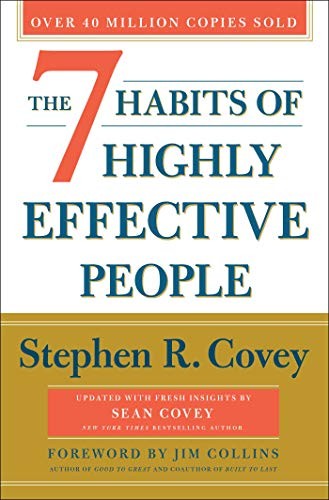
The 7 Habits of Highly Effective People
Stephen Covey, 1989
The idea in one sentence: Real effectiveness comes from character rather than technique, so work from the inside out: take responsibility for your responses, decide what your life is for, put those things first, and only then learn to work with others.
Covey's book has been on lists of the best self improvement books for more than thirty years, and the reason is habit one. Be proactive is the idea that there is a gap between what happens to you and how you respond, and your whole life is built inside that gap. Habit two, begin with the end in mind, asks you to write what you would want said about you at the end and plan backwards. Habit three gives you the grid that sorts urgent from important, still the best single tool for a week that feels out of control.
The everyday example is a Sunday evening. Covey would have you spend fifteen minutes finding the two or three important-but-not-urgent things and booking them before the week fills with urgent trivia. Done for a month, this changes what your weeks are made of.
Why eleven: the book is long, the corporate language has aged, and the middle habits on win-win and synergy say less than they seem to. Habits 1, 2 and 5 hold most of the value, and our summary gives you those.
- When something goes wrong, pause before responding and name what is inside your control; act only on that.
- Write three lines about what you want your life to have been about, then check this month's calendar against them.
- On Sunday, book two important-but-not-urgent tasks before the week fills up with urgent ones.
Read it if: you want one book to organise everything else on this list, and you have patience for a long read.
Skip it if: you need help by Friday; there are faster books higher on this list.
Begin with the end in mind. - Stephen Covey

Think and Grow Rich
Napoleon Hill, 1937
The idea in one sentence: A specific, burning desire, repeated until you believe it, backed by a written plan, stubborn persistence and a small group of allies, is what separates people who get what they want from people who wish for it.
This is the oldest book on the list and the one that needs the most care. Hill claimed that Andrew Carnegie commissioned him to study 500 of the richest men in America over twenty years, and that the 13 steps are what they shared. No record of the Carnegie meeting has ever been found, and Hill's own life included business failures and claims that do not check out. Several of the steps, including sex transmutation, the subconscious mind as a receiving station and the sixth sense, are 1937 mysticism with nothing behind them.
It is here because four of the steps are the roots of almost every goal-setting method written since. The six-step formula, fix an exact target, decide what you will give for it, set a date, make a plan and start now, write it down, read it aloud daily, is a usable version of what Covey and Clear teach eighty years later. The mastermind, a small group that holds each other to account, is probably the most copied idea in business self improvement. And the chapter on persistence, with its man who quit digging three feet from gold, describes how most people abandon a skill just as it starts to work.
Why twelfth: the useful quarter of the book fits on two pages, the rest ranges from dated to untrue, and the money framing sits awkwardly with personal growth. Our summary separates the planning advice from the mysticism.
- Write one goal as a sentence with an exact target, a date and what you will give for it, and read it every morning for a month.
- Meet two or three people working on something similar every fortnight to report progress; the accountability does more than the advice.
- When you want to quit, ask honestly whether you are three feet from gold or digging in the wrong place.
Read it if: you are curious about the source of modern goal-setting and can read a 1937 book with 2026 scepticism.
Skip it if: you want evidence; take the six-step formula from the summary and leave the rest.
Whatever the mind of man can conceive and believe, it can achieve. - Napoleon Hill
Which self improvement book should you read first?
- If you want any improvement to last past the third week, start with Atomic Habits, because it fixes the doing, which every other book on this list takes for granted.
- If you want better conversations with a partner, a teenager or a boss, start with Supercommunicators, because you will use it the same evening.
- If you want to get better at your actual work, start with Deep Work, because one protected hour a day speeds up every other skill.
- If you want to learn something new, a language, an instrument, a trade, start with Ultralearning, because it shows how adults actually learn fast.
- If you want to stop drowning in commitments before you add any, start with Essentialism, because you cannot grow in time you have already given away.
- If you want to be wrong less often about money, jobs and people, start with Thinking, Fast and Slow, because it gives you names for the mistakes, and a named mistake is easier to catch.
Self improvement books that are overrated
The Power of Habit by Charles Duhigg is an honest piece of journalism that introduced millions of people to the cue, routine and reward loop. The problem is that it explains how habits work rather than how to build one, and the stories, from Febreze to a casino gambler, run far longer than the lessons inside them. Atomic Habits took the same science, added the tools and cut the padding. Read Duhigg's Supercommunicators instead; it is the better of his books for your week.
Grit by Angela Duckworth made passion and perseverance the most quoted idea in education, and the underlying point, that sticking at hard things matters more than raw talent, is true. The trouble is the science. A 2017 meta-analysis of 88 studies found that grit predicted performance only modestly and overlapped almost completely with conscientiousness, a trait psychologists had measured for decades. The book also says little about how to become grittier. Read Hidden Potential for the kinder, better-evidenced version of the argument.
The Magic of Thinking Big by David Schwartz turns up on many lists of the best self improvement books. It was published in 1959, and it reads like it: believe you can succeed, cure yourself of "excusitis", think and dress like the person you want to be. There is real value in the point that people set their own ceilings low, but the book has no method beyond pep, and anyone who has read Mindset has already met the useful idea with evidence attached. It is a motivational speech in book form; enjoy it, then read something with steps.
Read next
Questions people ask
What is the best self improvement book of all time?
By influence, The 7 Habits of Highly Effective People and Think and Grow Rich. By what helps a busy adult today, Atomic Habits, because it is the only book in the genre built around keeping an improvement going after the first bad week. By evidence, Thinking, Fast and Slow, which rests on a Nobel Prize's worth of research rather than one author's story.
What self improvement book should I read first?
Match the book to the skill you want, not to its fame. Atomic Habits if nothing sticks, Supercommunicators if conversations go wrong, Deep Work if your work needs thought, Ultralearning if you want to learn something new, Essentialism if your week is already full. If you cannot choose, read the sections on this page, pick the one that sounds like your month, and read that book in full.
Do self improvement books actually work?
They work when they give you a method and you use it for at least two weeks. Habit books work when you apply one rule, communication books the same evening, learning books when you have a real project. What does not work is reading ten of them in a row for the feeling of progress. One book, one idea, tried for a fortnight, beats a shelf of unread ones.
What are the best books for personal growth?
For personal growth in the broad sense, we would pick Atomic Habits for the doing, Hidden Potential for believing you can still improve, Thinking, Fast and Slow for judgement, Supercommunicators for other people and Outlive for the body. If you want growth in mood or self-worth rather than skill, our separate list of the best self-help books covers Feeling Good, Mindset and Daring Greatly.
What is the number one self improvement book?
There is no official number one. On reader sites such as Goodreads, The 7 Habits of Highly Effective People and How to Win Friends and Influence People usually top the lists, with Atomic Habits the fastest riser. Our number one is Atomic Habits, because more of its advice is still in use after a normal week than anything else we tested.
How many self improvement books should I read?
Fewer than you think, and more slowly. One good book a month, read in full with one idea put into practice, does more than two a week skimmed. A reasonable year is four to six books, chosen for the skill you need next, with the rest covered by summaries. If you have read five self improvement books and changed nothing, the next step is not a sixth book but a two-week trial of one idea.
Books in this article
Atomic Habits
Small habits, repeated daily, compound into big results. Build them with four simple laws.
Deep Work
Four hours of real concentration beat ten hours of busy work. Protect them with rituals and a hard stop.
The 7 Habits of Highly Effective People
Work from the inside out: take responsibility, decide what matters, do that first, then seek to understand before being understood.
Think and Grow Rich
A definite goal, a written plan, daily repetition and a mastermind group. Four useful ideas wrapped in 1937 mysticism.